Content
How Advanced Automation Enables Reshoring Without Sacrificing Profitability
The math seems insurmountable. Labor costs in North America and Western Europe run 5-10 times higher than in Southeast Asia. For labor-intensive manual assembly, this cost differential makes domestic production economically impossible, so offshore wins on price every time. Yet recent supply chain disruptions revealed the enormous risks of offshore dependency. This has led domestic manufacturers to wonder if they can achieve economically viable domestic or nearshore production, or if cost-competitive reshoring simply wishful thinking.
The only sustainable path to competitive domestic manufacturing is reducing direct labor to a negligible percentage of total cost. When assembly cost is dominated by equipment and materials rather than human wages, geographic wage differences become largely irrelevant. A facility where labor represents 10% of cost experiences minimal disadvantage from 5x wage differences. In contrast, a facility where labor represents 60% of cost has no hope of overcoming the gap.
But changing from the 60% labor profile to the one where labor is only 10% of total cost requires comprehensive automation. In other words, it’s not enough to simply automate a few simple tasks while leaving complex operations manual. Instead, the manufacturer needs to achieve end-to-end automated assembly that truly eliminates labor dependency.
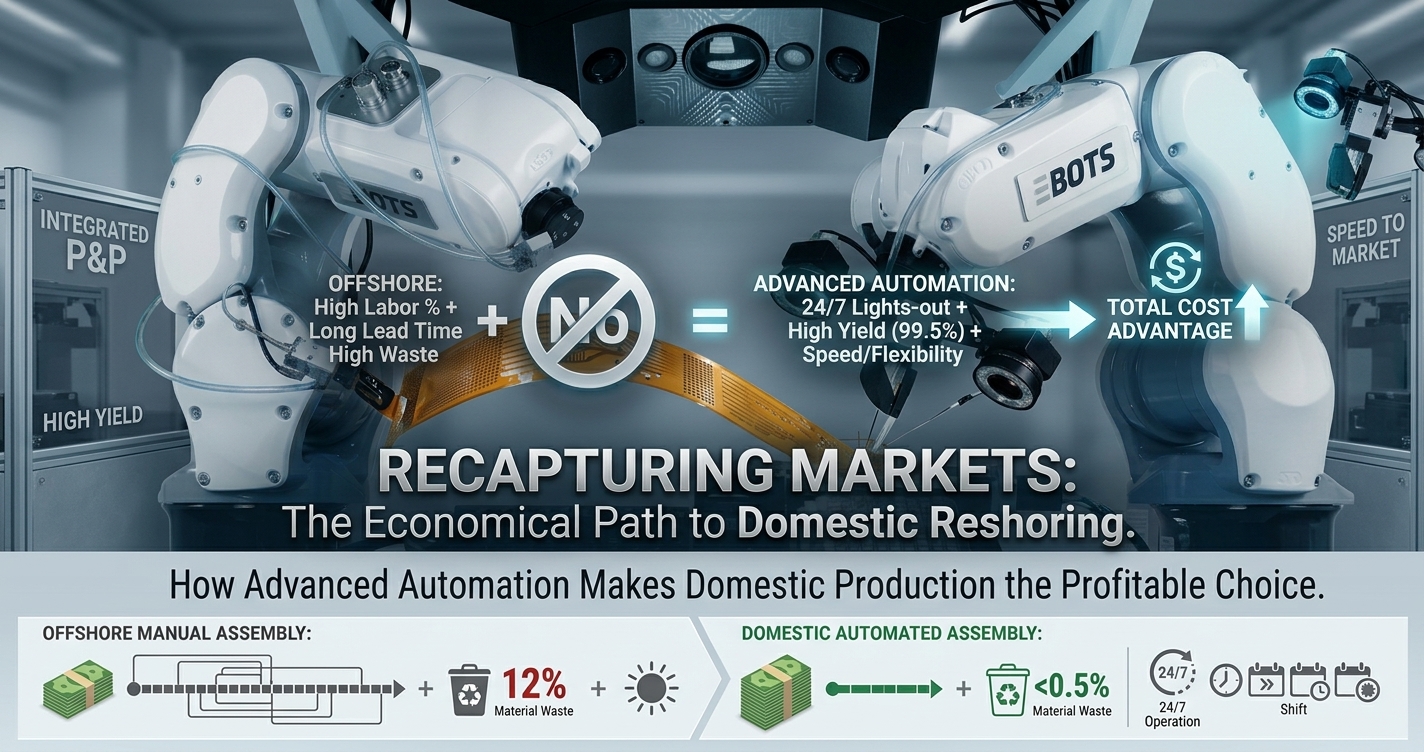
Keep in mind that equipment costs exactly the same amount, whether it’s operating 8 or 24 hours a day. With this in mind, it’s stands to reason that domestic facilities can achieve cost competitiveness by maximizing utilization through multi-shift or lights-out operation. Running three shifts amortizes equipment investment across three times as much production, which dramatically reduces per-unit costs.
While this approach is impractical with manual labor due to shift premiums, supervision challenges, and workforce availability constraints, it’s perfectly natural for automated systems that were designed for continuous operation. As a result, a domestic automated facility running 24/7 can economically compete against an offshore manual facility operating single shifts, because the utilization advantage offsets wage differences.
Additionally, advanced automation can operate at speeds that exceed human capability by a factor of 2x or more. This throughput advantage means that less equipment is needed to achieve equivalent production volume. Combined with higher first-pass yields (99%+ versus 85-92% for manual production), the effective cost per good unit drops substantially.
And to sweeten the pot even further, quality improvements also reduce warranty costs, rework expenses, and customer returns. These are all costs that offshore manufacturers externalize but that erode actual profitability when fully accounted for.
To be clear, domestic manufacturing offers inherent advantages that can justify premium pricing: lead times measured in days rather than weeks; the ability to quickly respond to engineering changes without international coordination delays; easier collaboration on new product introduction and problem-solving; reduced logistical and inventory carrying costs; and the elimination of tariff risks and currency fluctuations.
For customers where speed-to-market determines competitive success, these advantages have real economic value that offsets moderate cost premiums.
Domestic manufacturing can also differentiate through flexibility that high-volume offshore facilities simply can’t match. With rapid changeover capabilities that enable the economic production of small batches, custom configurations, and frequent product iterations, domestic facilities can target market segments where offshore manufacturing struggles.
Products that require close customer collaboration, frequent engineering changes, or quick-turn prototyping favor proximity over low labor costs. This responsiveness and capability is precisely where domestic manufacturing can compete, rather than focusing exclusively on price.
In electronics manufacturing, material costs often exceed labor costs. A complex flexible PCB assembly might contain $30-50 in components but only $10-15 in direct labor. Therefore, automation that improves yield from 88% to 99.5% on a $40 assembly dramatically shifts the cost narrative, because it saves $4.60 per unit in material waste. This amount often exceeds the labor cost differential between domestic and offshore production, thereby turning the tables on the offshore argument.
This example illustrates how focusing optimization on material efficiency rather than purely on labor costs fundamentally changes the economic equation. It’s now clear that domestic automated manufacturing can achieve lower total costs than offshore manual assembly when material waste is properly accounted for.
This becomes even more critical when it comes to products such as medical devices, aerospace components, and automotive safety systems, which prioritize quality and traceability over cost. Customers in these segments will pay premiums for demonstrated process control, complete traceability, and regulatory compliance. These are all areas where advanced automated manufacturing excels.
In short, this means that domestic facilities with superior quality systems can command pricing that more than offsets cost disadvantages, while accessing high-margin market segments where offshore competitors struggle to meet requirements.
Reshoring has to make economic sense. If it’s based exclusively on patriotism or supply chain anxiety, it isn’t sustainable. Advanced automation is the essential enabler, transforming domestic manufacturing from a cost disadvantage into a competitive advantage based on speed, quality, flexibility, and responsiveness.
Without this transformation, domestic flexible PCB manufacturing faces continued gradual decline. But with the transformation, a renaissance becomes possible. It won’t be through subsidies or trade barriers, but rather through fundamental productivity advantages that make domestic production the economically rational choice.
The technology already exists. So, the question is whether manufacturers will embrace it quickly enough to recapture markets they’ve already lost to offshore alternatives, or if they’ll continue declining while they debate whether change is necessary.
For more information, read the white paper, The Technology Blueprint for Next-Generation Flexible PCB Automation (no registration required).