Content
Strategic Guidance for Manufacturers Navigating the Automation Journey
The transition from manual to automated assembly doesn’t just represent equipment acquisition, but organizational transformation, as well. Manufacturers who treat it as a simple technology purchase typically encounter disappointing results, such as having systems that underperform expectations, integration challenges that weren’t anticipated, and ROI that takes far longer than projected. Success requires strategic planning, systematic execution, and organizational commitment to change.
Start With Brutal Honesty
Before selecting solutions, it’s important to deeply understand your current state. In addition to knowing the official process documentation, you really need to have a firm grasp on how work actually happens. Then you need to map all processes, including the manual interventions and workarounds that aren’t listed in the procedures. Additionally, be sure to measure the true performance of the system, including yield rates, cycle times, changeover durations, and defect escapes. And these must be the actual, true numbers, not your target values.
Once these steps are complete, you’re ready to identify the genuine bottlenecks that are limiting production. Is it placement speed, inspection capacity, changeover time, or quality issues that are creating the need for rework? Then, quantify your total costs and be sure to include hidden expenses like scrap, rework, warranty claims, and quality escapes. Document any skill dependencies, so you fully understand which processes rely on the expertise of specific individuals, so you have a strong sense of what disappears when they leave.
This honest assessment often reveals that the assumed problem isn’t the actual constraint. Automating the wrong process delivers disappointing results while leaving real limitations unaddressed.
Define Measurable Objectives
Automation justification should focus on specific business objectives, rather than technology for its own sake. Are you solving workforce shortages and turnover problems that limit growth? Are you improving quality to meet customer requirements or win new business? Increasing capacity without facility expansion? Reducing time-to-market for competitive advantage? Enabling reshoring of production currently offshore?
It’s also important to note that different objectives lead to different automation strategies. For example, workforce replacement prioritizes reliability and ease of operation; quality improvement emphasizes precision and process control; and flexibility for high-mix production demands rapid changeover capability. Having clarity about your primary objectives focuses your solution evaluation and prevents you from inadvertently compromising on critical requirements.
Take a Staged Approach
Attempting complete facility automation overnight is high-risk and rarely successful. Instead, it’s important to first identify the highest-value opportunity. This might be the process with the worst quality issues, the bottleneck limiting throughput, or the product line with the most severe workforce challenges. Once you’ve identified the opportunity, implement automation there first so you can learn from the experience, demonstrate ROI with concrete data, and build internal expertise and organizational confidence. Then you can expand systematically to additional areas by replicating successes and avoiding repeated mistakes.
This staged approach also manages financial risk, since you’ll prove the value of the changes before making major capital commitments, rather than betting the business on an unproven technology.
Consider Pilot Programs
Starting with pilot deployments allows validation of technology fit for your specific applications, proving ROI with real data before making a major commitment, identifying integration challenges at manageable scale, and building stakeholder confidence through demonstrated success.
Many successful automation programs began with skeptical pilots that proved their value and therefore expanded to a comprehensive deployment. Conversely, many failures resulted from large-scale implementations where the pilot validation step was skipped, resulting in the company committing millions before discovering that the technology couldn’t actually handle the products.
Invest Beyond Equipment
Automation success requires more than machines. Facilities need appropriate environmental controls such as temperature and humidity stability for precision work; reliable utilities such as stable power, and clean compressed air; network infrastructure to support digital integration; and proper ESD controls. Attempting to automate facilities that lack this essential underlying infrastructure will lead to disappointing results that reflect environmental limitations rather than equipment capability. So, be sure to budget for facility preparation in addition to the equipment purchase.
Plan for Integration
Automated systems can’t live on an island unto themselves. Instead, they need to integrate with existing equipment and processes. This requires you to understand communication protocols and data interfaces, have the ability to plan material flow into and out of automated cells, be able to coordinate with upstream and downstream processes, and to ensure that MES/ERP systems can exchange data with the automated components.
Integration engineering often requires as much effort and cost as the equipment deployment itself. Underestimating this leads to isolated automation cells that don’t integrate with factory workflows. In turn, this creates a situation where only partial value is delivered while new problems are created.
Commit to Training
Equipment is only as effective as the people who operate and maintain it, so be sure to budget for comprehensive training. This includes training operators on system operation and basic troubleshooting, technicians on maintenance and advanced diagnostics, engineers on process development and optimization, and management on how automation changes workflows and their overall responsibilities.
It may seem expensive at first, but proper training is an absolutely essential investment. In fact, skimping on training virtually guarantees underperformance and extended ramp-up times.
Embrace Organizational Change
Automation transforms more than production processes; it changes organizational structure, skills requirements, and workflows. Some employees resist, due to fears of losing their jobs or their skills becoming obsolete. To counteract these fears, managers must lead change by communicating why automation is necessary for business viability. Affected employees should be involved in planning, and displaced workers should be redeployed to higher-value roles where possible. Finally, automation successes should be celebrated to build momentum.
Organizations that treat automation as purely technical while ignoring human and cultural dimensions will experience resistance that undermines results.
Measure, Learn, Optimize
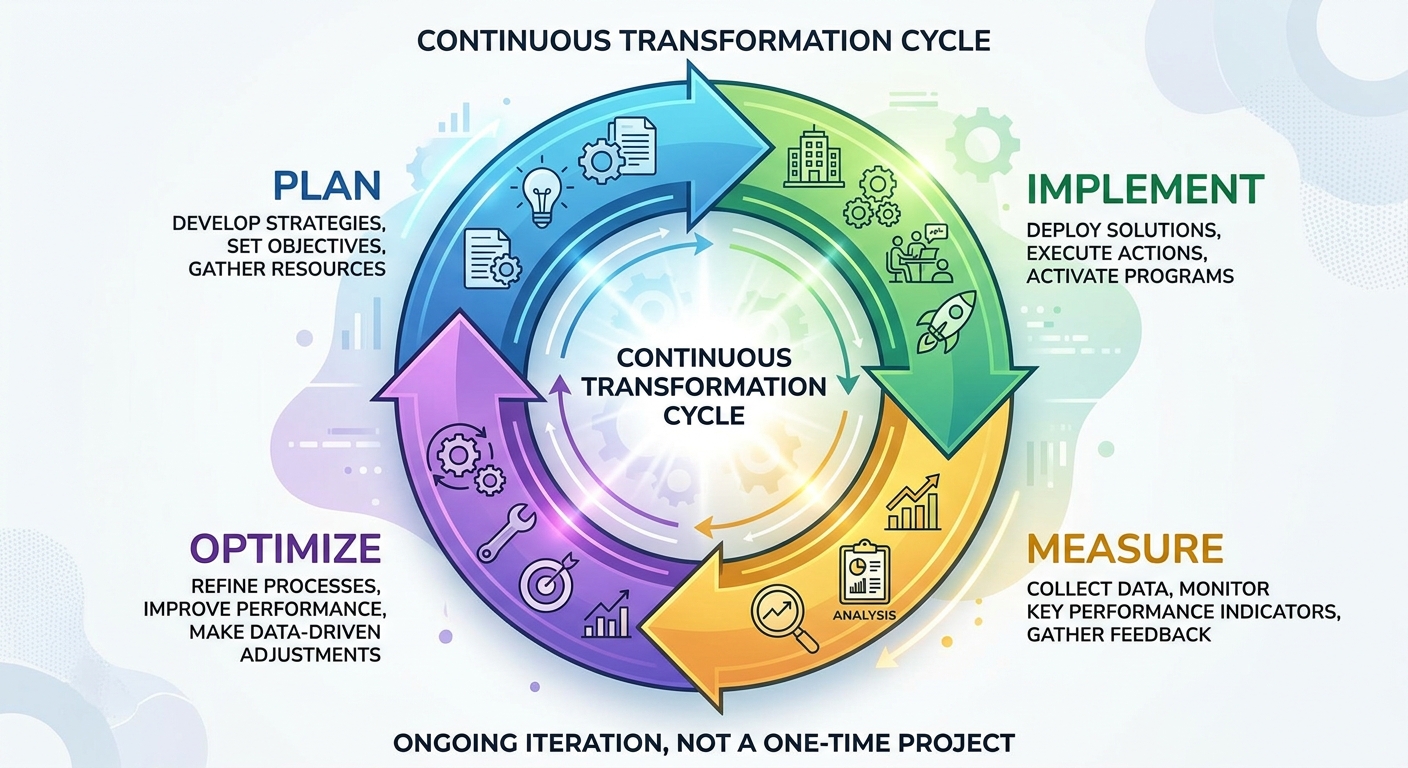
Initial automation deployment is just the beginning. It’s also essential to establish and rigorously track clear metrics such as yield, throughput, uptime, quality, and cost per unit. It’s also important to use data to identify improvement opportunities and benchmark against targets and industry standards. In short, treat automation as continuous improvement journey, instead of just a one-time project.
The difference between good and great automation implementations often comes down to what happens in the next six to 24 months. That’s the timeframe in which it will be determined whether the organization continuously optimizes or declares victory and moves on.
The Long View
Automation transformation typically requires years for complete facility conversion, so success requires patience, persistence, and long-term leadership commitment. But manufacturers who successfully navigate this transformation emerge with sustainable competitive advantages that define their future for decades.
The question isn’t whether the journey is difficult, because it clearly is. It’s whether the destination is worth the effort. For manufacturers facing workforce crises, quality demands exceeding manual capability, and competition from more advanced operations, the answer is increasingly obvious. The only question is whether to start the journey now, or to wait until competitive pressures make transformation an emergency rather than a strategic choice.
For more information, read the white paper, From Manual to Automated: A Strategic Roadmap for Manufacturing Transformation (no registration required).