Content
Why Traceability and Process Control Often Justify Automation More Than Labor Savings
When manufacturers evaluate automation ROI, the conversation typically focuses on reducing labor costs. Simply replace X manual assemblers at Y annual cost, and you’ll achieve payback in Z months. It’s a straightforward calculation that resonates with finance teams. But this labor-centric analysis often misses the larger value proposition which is particularly pronounced for manufacturers pursuing regulated markets where quality, traceability, and compliance requirements create enormous hidden costs.
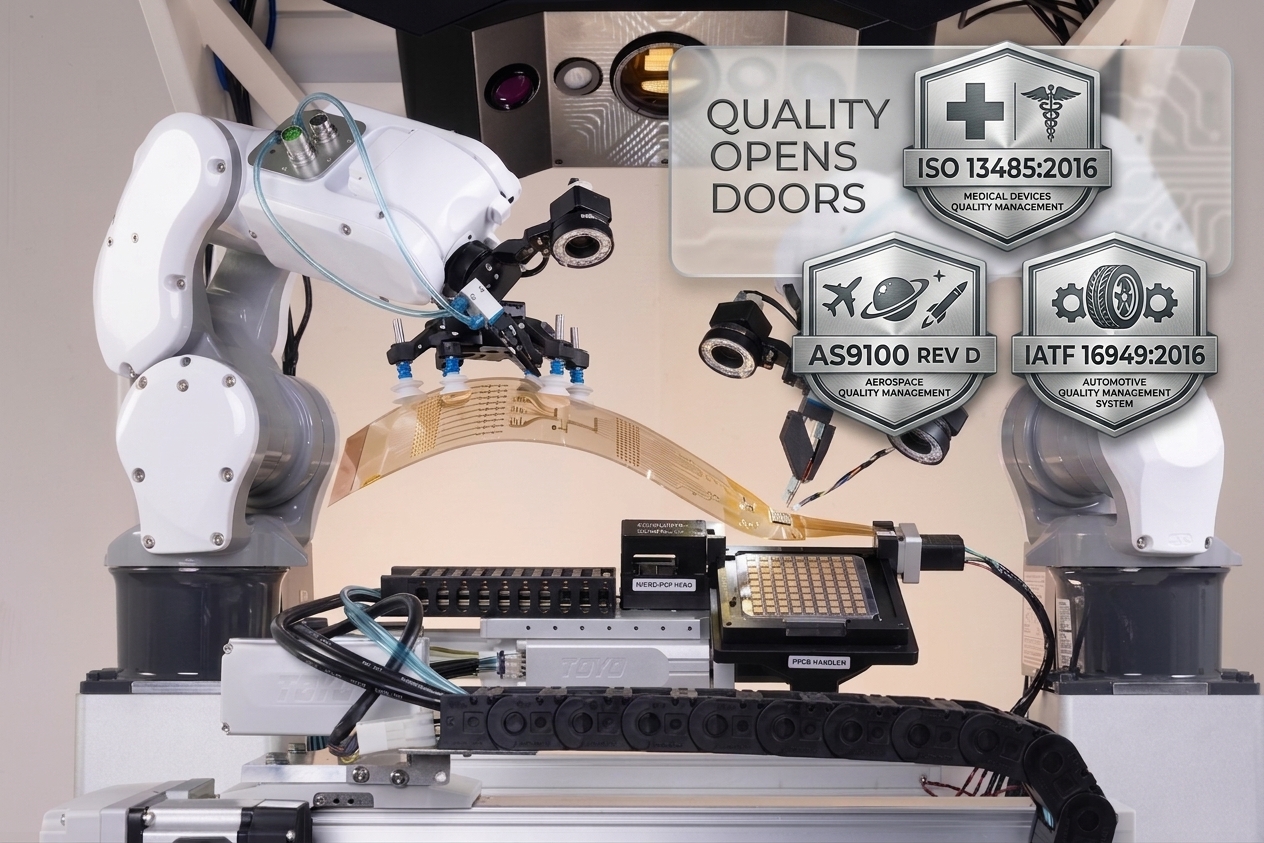
Medical device, aerospace, and automotive electronics manufacturers face stringent requirements that fundamentally shape manufacturing economics. It’s insufficient to simply build products. Instead, you must prove how they were built, with what materials, under what conditions, and with complete traceability from components to finished goods.
Manual processes can theoretically provide this documentation, but the administrative burden of doing it that way is staggering. Think about it: operators would need to record component lot numbers manually, document process parameters on paper forms, log environmental conditions periodically, and create device history records for every unit. The paperwork would consume substantial amounts of time — as high as 20-30% of direct labor — and it would be rife with errors. Handwritten logs would frequently be incomplete; operators would often forget to record component lot changes; and process deviations would go undocumented.
Now think about the costs of manual compliance. Consider a medical device manufacturer that produces 100,000 units annually with manual assembly. If documentation adds 20% to direct labor time and assemblers cost $40 per hour fully loaded, that’s approximately $800,000 annually just for compliance paperwork. And that’s before accounting for errors, audits, or corrective actions when documentation proves inadequate.
Quality escapes would dramatically compound costs. A defect caught on the production line might cost $5 in materials and labor, whereas the same defect caught at final test would cost $50 with rework included. If it reaches a customer, the cost explodes to more than $500 in warranty, returns, and reputation damage. And for medical devices, field failures can trigger investigations with costs soaring into the millions.
Manual processes with 85-92% first-pass yield guarantee substantial quality costs. On products with $40 material cost, a 10% defect rate wastes $4 per unit in materials alone. That means $400,000 annually on 100,000 units, before considering rework labor or downstream impacts.
Conversely, advanced automated systems inherently provide what regulations demand, because complete digital traceability is automatically generated as a byproduct of production. Component barcodes are automatically scanned and linked to assemblies electronically. Additionally, process parameters are recorded by machine controllers without manual entry, vision systems capture images of every placement, and environmental sensors continuously log conditions.
This eliminates the labor cost of manual documentation while dramatically improving accuracy and completeness. But the value extends beyond just the cost savings. Complete traceability enables root cause analysis when issues occur, supplier quality management with data rather than intuition, process optimization through comprehensive analytics, and audit readiness without scrambling to compile documentation.
What’s more, many high-value market segments are simply inaccessible to manufacturers with manual processes. Medical device and aerospace customers increasingly require demonstrated process capability through statistical evidence that manufacturing processes are controlled and capable of consistently meeting specifications.
Manual processes struggle to demonstrate this because human variation makes achieving Cpk >1.67 (let alone >2.0) difficult. Control charts show wide distributions and capability studies reveal processes that are barely capable of meeting requirements with no margin.
On the other hand, automated systems with ±22μm placement accuracy that assemble components with ±100μm tolerances demonstrate enormous process capability. Control charts show tight distributions centered on targets and capability studies prove processes exceeding requirements with substantial margins. This documentation opens access to premium-margin market segments that manual operations simply can’t pursue.
Let’s calculate quality improvement ROI separately from labor savings. A facility that produces 500,000 flexible PCB assemblies annually with $40 material cost and 88% first-pass yield wastes $2.4 million in materials annually. Improving yield to 99.5% reduces waste to just $200,000 which is a $2.2 million annual savings in materials alone. Add rework labor elimination, warranty cost reduction, customer return decreases, and improved pricing power from quality reputation, and the total quality-driven value often exceeds labor savings. Yet manufacturers fixated on labor displacement still miss this larger opportunity.
For manufacturers pursuing medical, aerospace, or automotive markets, automation isn’t optional — it’s the only practical path to regulatory compliance at reasonable cost and quality levels these customers demand. As a result, labor savings become a bonus rather than the primary justification.
Therefore, the business case shifts from whether or not the manufacturer can afford automation to whether they can afford to remain manual and be excluded from high-value markets. The answer increasingly is no, because the opportunity cost of market inaccessibility exceeds the amount required for automation investment many times over.
Even for manufacturers not facing regulatory requirements, quality improvement delivers measurable ROI, because every percentage point of yield improvement flows directly to profitability. Likewise, every reduction in customer returns strengthens relationships and reputation, and every decrease in rework frees capacity for revenue-generating production.
Automation delivers quality improvements that manual processes can’t match. And this isn’t just as a side benefit, but rather as a primary value driver. Manufacturers who recognize this build different business cases with stronger ROI and strategic justification than those that are purely focused on labor displacement.
The question isn’t whether quality matters, because it obviously does. It’s whether manufacturers properly account for quality value when evaluating automation, or if they leave the largest benefits uncounted for because they’re harder to quantify than labor savings.
Those who count all the benefits make different decisions and gain competitive advantages their labor-focused competitors miss entirely.
For more information, read the white paper, Quality and Compliance in Automated Flexible PCB Manufacturing (no registration required).