Content
The Complete Solution for Flexible Circuit Manufacturing Transformation
For the first seven blog posts in this series, we’ve examined the challenges facing flexible PCB manufacturers, including workforce crises, quality demands, competitive pressures, precision requirements, and the fundamental limitations of traditional automation. We focued on those, because understanding problems is essential. But at the end of the day, it’s solutions that precision manufacturers actually need.
As a result, this post examines how eBots specifically solves the challenges we’ve documented. Not theoretically, but in real production environments delivering measured results.
Purpose-Built for Flexible Circuits
eBots wasn’t adapted from rigid board automation. It was designed from the ground up specifically for the unique demands of flexible circuit assembly. Every architectural decision addresses the specific limitations that make conventional automation fail for flexible PCB applications. The result is a complete solution that implements every capability that was identified as essential in the previous posts.
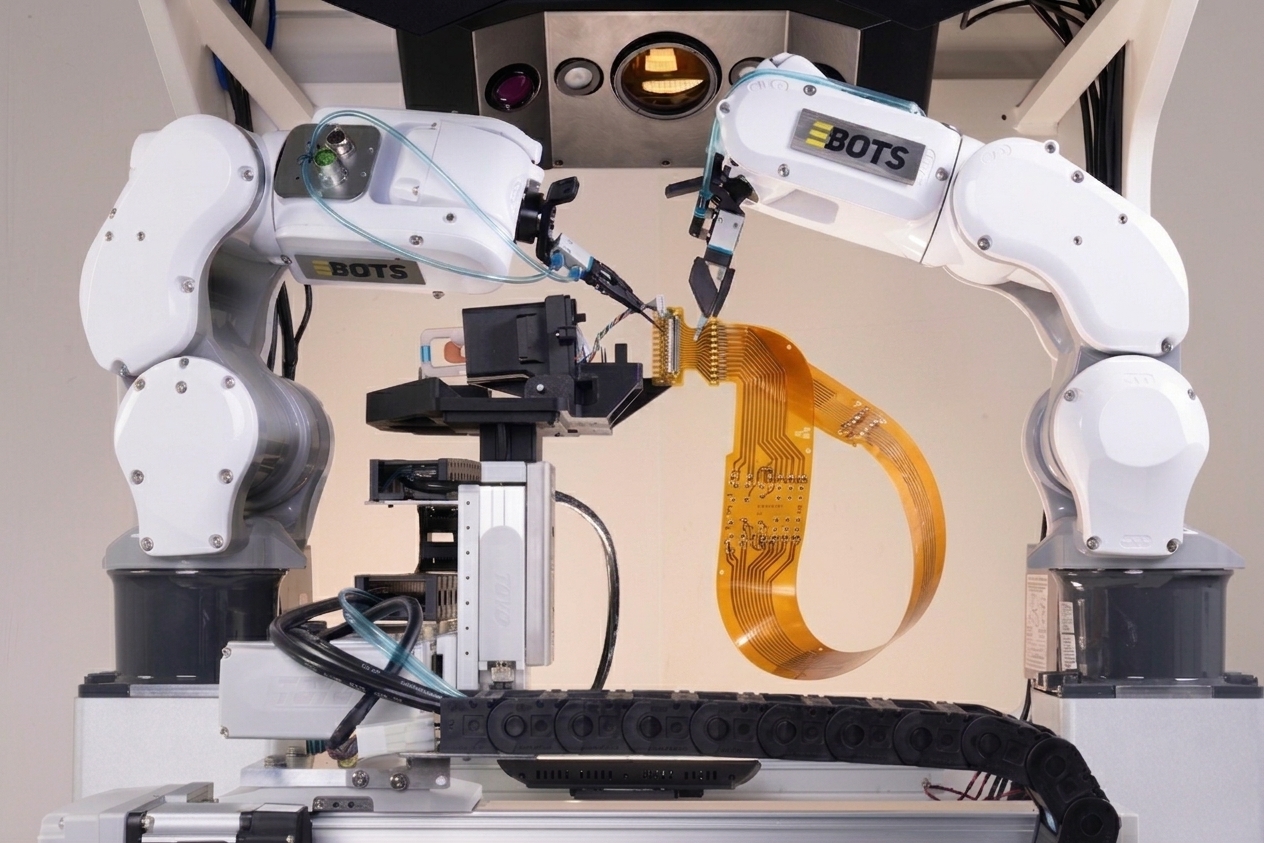
Synchronized dual-arm coordination replicates the two-handed manipulation that’s required by flexible circuit assembly. One arm secures delicate substrates with minimal holding force while the other performs precision component placement. Both arms work together to perform operations that single-arm systems architecturally can’t perform and that have forced manufacturers to retain manual assembly for their most complex operations. This includes routing cables, installing shields, and assembling connectors.
Adaptive force control senses substrate characteristics in real-time and dynamically adjusts placement pressure. This capability enables handling of ultra-thin substrates that have a thickness of 25 microns or less without tearing or deformation, while ensuring proper component seating across varying materials and environmental conditions. Fixed-force traditional automation simply damages what eBots routinely handles.
Three-dimensional vision operating at 409 frames per second provides comprehensive quality verification that two-dimensional imaging simply can’t deliver. Component height verification, substrate topology mapping, solder paste volume measurement, and post-reflow joint analysis all occur automatically to detect defects that are invisible to conventional vision systems.
Placement precision of +/- 22 microns, which is five times finer than human hair, enables reliable assembly of the most demanding flexible circuit applications. And rather than degrading over time, this extraordinary level of precision is sustained across millions of placements through continuous automated calibration.
AI-driven learning continuously improves performance without the need for manual reprogramming, so new products benefit from knowledge accumulated across previous variants. As a result, the system becomes more capable over its operational life rather than plateauing after initial setup.
Real Customers. Measured Results.
And these capabilities aren’t theoretical. These three customer results illustrate what eBots delivers in practice:
A medical device manufacturer that produces wearable continuous glucose monitors struggled with 87% first-pass yields, four to six week new product introduction timelines, and the inability to demonstrate the process capability required for ISO 13485 certification. After deploying eBots, yields improved to 99.7% and new product introduction dropped to three to five days. ISO 13485 certification was also achieved in eight months, which opened European markets that represented 30% of company revenue within two years. As a result, their return on investment occurred in 11 months, driven primarily by quality improvement rather than labor savings.
An automotive electronics contract manufacturer facing intense offshore price pressure implemented eBots to make domestic production economically viable. Labor cost per unit dropped 65%. Yields also improved from 91% to 99.8% percent, which saved them nearly $2 million annually in material waste and rework. And IATF 16949 certification enabled them to pursue automotive safety system business at double their commercial margins. In all, the company reshored $15 million in annual revenue that was previously sourced from China. As a result, return on investment occurred in 14 months.
A high-mix consumer electronics manufacturer producing between 50 and 70 active product variants each month reduced their changeover time to just 15 minutes, thereby enabling daily production to match actual orders. As a result, inventory dropped by 60%. New product introduction also accelerated from three weeks to four days, creating a premium-priced rapid prototyping service that generates more than $1 million in new revenue annually. Return on investment occurred in just nine months.
The Bottom Line
Every challenge documented in this blog series has a proven solution. Whether you’re facing workforce shortages, quality demands, precision requirements, high-mix economics, compliance burdens, or competitive pressures, eBots addresses them through purpose-built technology that delivers measurable results in production environments.
The transformation is achievable. The results are proven. The only question is when manufacturers will commit to capturing them.
For more information, read the white paper, eBots Transforms Flexible PCB Manufacturing Through Next-Generation Adaptive Robotics (no registration required).