Content
Automated Assembly Systems: A Comprehensive Guide

Manufacturing is changing. Traditional assembly lines, often staffed by hundreds of people, are struggling with modern demands. High employee turnover, which hovers around 40% in the manufacturing sector, creates a constant cycle of hiring and training. On top of that, unplanned absences can slash productivity by as much as 37%, and the natural variability of human work leads to inconsistent quality.
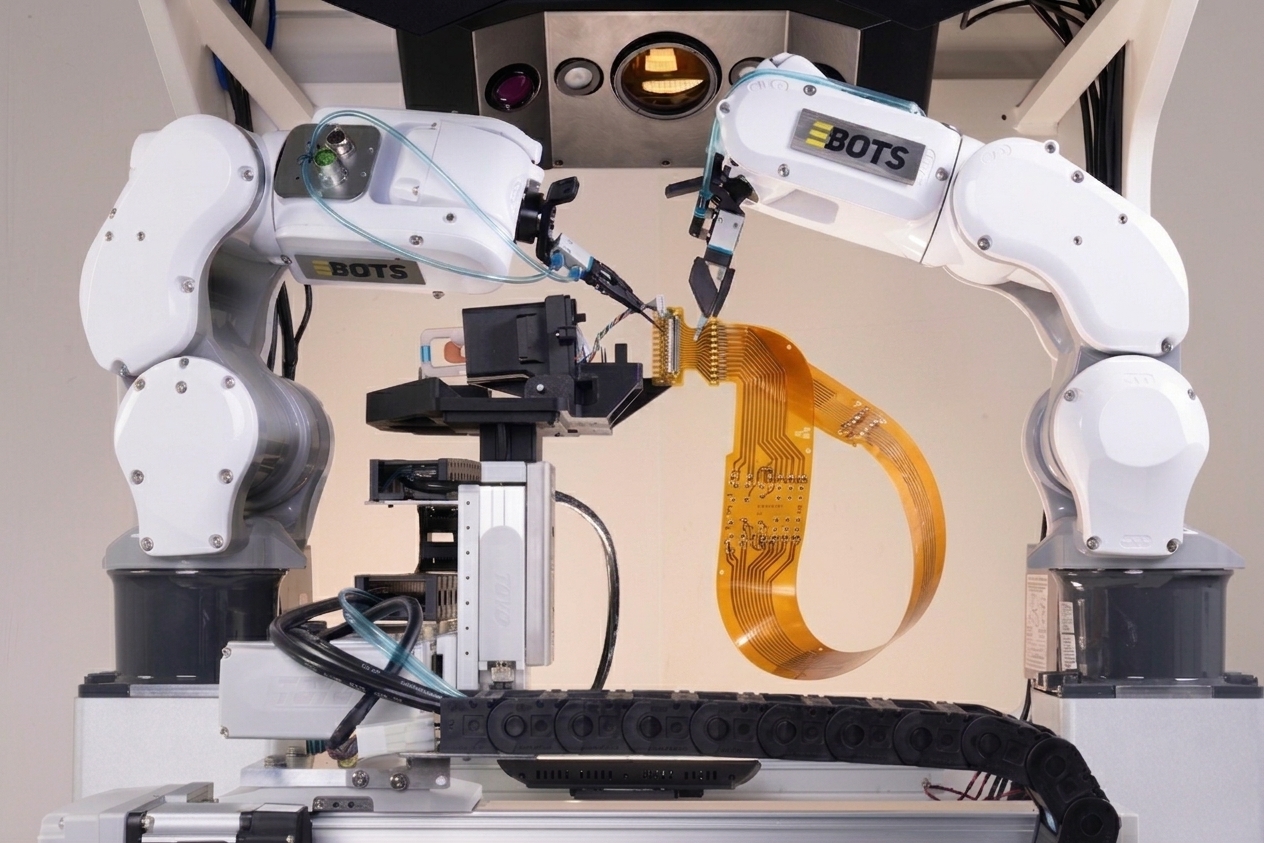
To solve these challenges, companies are turning to automated assembly systems, which are manufacturing lines that use robots, machines, and control systems to build products with minimal human intervention. These systems promise consistent, 24/7 operation and a level of precision that humans simply can’t match. Advanced solutions, like the AI‑driven robotic cells developed by Ebots, deliver ultra high precision for reliable, round the clock production.
This guide will walk you through everything you need to know about automated assembly systems, from their basic components and history to the design principles that make them successful.
What is a Fully Automated Assembly Line?
A fully automated assembly line is a production system where machines and robots perform nearly all assembly tasks with minimal human intervention. From feeding parts and joining them together to inspection and packaging, the entire process is orchestrated by computer control systems.
These systems are the heart of the modern “smart factory,” enabling lights‑out manufacturing where production continues long after the last person has gone home. While some staff is usually on hand for monitoring and maintenance, the direct labor of building the product is handled entirely by machines.
The Core Benefits of Automated Assembly Lines
Why make the switch? The advantages are clear and impact everything from output to your bottom line.
Massive Productivity Boost: Robots don’t need breaks, vacations, or sleep. They can operate 24/7 at high speeds, dramatically increasing throughput. Early industrial robots were even promoted as tireless workers that never ask for a raise.
Unbeatable Quality and Consistency: Human error is a leading cause of manufacturing defects. Automated systems perform tasks the exact same way every single time, reducing errors and improving first pass yield. See how automation in precision manufacturing raises first‑pass yield. For example, integrating an automated leak test station has been shown to cut defect rates to nearly zero in certain processes.
Lower Long Term Costs: While automation requires an upfront investment, it significantly reduces costs associated with labor, recruitment, and training. It also mitigates the impact of labor shortages and absenteeism, which can cripple manual operations.
Enhanced Worker Safety and Roles: Automation takes over the repetitive, strenuous, and often dangerous jobs. This allows companies to reassign skilled human workers to more valuable roles like process optimization, engineering, and quality management.
Data and Traceability: Every action in an automated system is logged. This wealth of data provides deep insights into the production process, enabling continuous improvement and complete traceability for every product that comes off the line.
A Quick Look Back: The History of the Automated Assembly Line
The journey to today’s smart factories has been over a century in the process.
It started in 1913 when Henry Ford introduced the first moving assembly line for the Model T. While still manual, it revolutionized production by bringing the work to the worker, cutting car assembly time down to just 93 minutes.
The next giant leap came in 1961 when General Motors installed the Unimate, the world’s first industrial robot. This robotic arm took on the dangerous task of handling hot metal parts, proving that machines could work reliably on the factory floor.
From there, adoption accelerated. The 1970s brought programmable logic controllers (PLCs), giving lines computerized coordination. The 1980s introduced machine vision for automated inspection. The number of industrial robots in use skyrocketed, growing from a few thousand in 1980 to over 1.6 million by 2015. Today, AI and machine learning are making automated assembly systems more intelligent and adaptable than ever before, as next‑generation autonomous robots demonstrate.
The Building Blocks: Components of an Automated Assembly System
An automated assembly system is more than just a collection of robots. It’s a synchronized ecosystem of hardware and software working in concert.
System Structure and Core Components
The structure of an automated assembly line is its physical layout and workflow organization. While some are simple straight lines, many modern systems use U‑shaped or modular cell layouts to maximize space and efficiency.
The core components that make up these systems include:
Conveyor Systems: These are the arteries of the line, moving parts and products between stations.
Industrial Robots: These are the workers, performing tasks like welding, gripping, and placing parts.
Parts Feeding Systems: These devices, like bowl or step feeders, automatically supply and orient components for the robots to pick up.
Control System: Often a Programmable Logic Controller (PLC), this is the brain of the operation. It coordinates the actions of all robots, conveyors, and sensors to ensure everything happens in the right sequence.
Sensors and Vision Systems: These are the eyes of the line, used to detect parts, guide robots, and inspect for quality at every step.
Specialized Systems on the Line
Depending on the product, an automated assembly line can include various specialized stations.
Welding System: In industries like automotive, robotic welding cells perform precise, strong welds far faster and more consistently than human welders.
Marking and Traceability System: These systems often use lasers or dot peen markers to etch serial numbers or QR codes onto parts. This ensures every component can be tracked throughout its lifecycle, which is critical for quality control and recalls.
Testing System: Automated testing stations are integrated directly into the line to verify functionality. This can involve electrical tests, pressure tests, or functional checks to ensure a product works before it leaves the factory.
Leak Detection System: For products that need to be airtight or watertight, a leak detection system uses pressure or vacuum to find microscopic flaws. High throughput automated testers can inspect up to 1,200 parts per minute, a rate impossible to achieve manually.
Vision Inspection System: High resolution cameras paired with intelligent software can inspect products for cosmetic defects, correct component placement, and dimensional accuracy at incredible speeds.
Key Robotic Players
Two types of robots are especially common in automated assembly systems.
Pick and Place Robot: These robots are designed for speed and precision, moving parts from one location (like a feeder) to another (like the main assembly). They are workhorses for tasks like loading circuit boards or packaging products.
Palletizer: At the end of the line, a palletizing robot automates the process of stacking finished goods onto a pallet for shipping. They handle the heavy lifting, arranging boxes in stable, optimized patterns.
Finding the Right Fit: Levels of Automation
Not every line needs to be 100% automated. The right approach depends on your product, volume, and goals.
Semi Automated Assembly Lines and the Human Role
A semi automated assembly line is a hybrid system that combines the strengths of both machines and people (often a pragmatic step for plants transforming legacy operations). Automation handles the repetitive, high speed, or heavy lifting tasks, while human workers perform complex or delicate steps that require dexterity and judgment.
In these environments, the human role shifts from manual assembler to system operator, technician, or quality controller. People are essential for setting up machines, performing maintenance, troubleshooting issues, and overseeing the entire process to ensure it runs smoothly.
Strategic Approaches: Lean and High Throughput Automation
Lean Automation: This strategy applies the principles of lean manufacturing to automation. The goal isn’t just to automate, but to automate intelligently. It focuses on eliminating waste, using flexible and appropriately sized machines, and building in quality checks at every step. A core principle is Jidoka, or automation with a human touch, where machines are designed to stop automatically if they detect a problem, preventing defects from moving down the line.
High Throughput Automation: For high volume production, this approach focuses on maximizing speed and output. It uses parallel processing, incredibly fast machines, and optimized workflows to produce a massive number of units in a short time.
How to Select Automated Assembly Machines
Choosing the right equipment is crucial for success. Key factors to consider include:
The Task Itself: Is it a simple pick and place motion or a complex, multi step assembly?
Volume and Speed: How many units do you need to produce per hour or day?
Precision Requirements: What are the tolerances? How accurate does the machine need to be?
Integration: How will the new machine connect and communicate with your existing equipment?
Vendor Support: A reputable supplier provides not just a machine, but also the support, training, and service needed to keep it running for years.
Ready to explore how cutting edge automation could transform your production? Speak with an expert at Ebots to see how our solutions can address your biggest challenges.
Designing for Success: Making Products Robot Friendly
The most successful automated assembly systems start with a product that was designed for automation in the first place. This principle is known as Design for Automated Assembly (DFAA). For deeper guidance, explore our whitepapers on DFAA. The goal is to design parts and products with the capabilities of robots in mind, making the assembly process as simple and error proof as possible.
Core DFAA Strategies
Minimize Part Count: The simplest rule of assembly is that fewer parts mean fewer steps. Combining multiple components into a single molded part eliminates the need for robots to handle and fasten them.
Standardize Components: Using standard parts and modular sub assemblies simplifies everything from parts feeding to tooling.
Design for Top Down Assembly: Designing a product so it can be built in layers from a single direction (usually top down) is a huge win for automation. This leverages gravity and eliminates the need for complex machinery to flip the assembly over.
Incorporate Self Locating Features: These are design elements like guide pins, chamfers, or tabs that help parts align themselves automatically during assembly. They make the process more forgiving and reduce the need for ultra precise robot positioning.
Use Assembly Friendly Fasteners: Traditional screws and bolts are slow for robots. Whenever possible, DFAA favors faster methods like snap fit joints or clips that join parts with a simple push.
Key DFAA Design Considerations
Beyond the core strategies, designing for automated assembly systems involves thinking through the details.
Part Geometry and Orientation: Parts should be designed so they don’t tangle in a feeder and have features that allow them to be easily oriented in a consistent direction. A part that is difficult for a human to orient will almost certainly be difficult for a machine.
Tolerances and Fit: Robots aren’t as good as humans at wiggling a tight part into place. Designs should have tolerances and lead in features (like beveled edges) that accommodate slight variations in positioning.
Material and Gripper Compatibility: The product’s design must consider how a robot will pick it up. This means providing flat surfaces for suction cups or stable features for mechanical grippers to grab without damaging the part.
Assembly Sequence and Access: Designers must plan the step by step assembly order to ensure that each new part can be added without being blocked by previously installed components.
Diving Deeper: Key DFAA Concepts Explained
Part Orientation: This refers to ensuring a component is correctly positioned before the robot picks it up. Parts feeders are designed to sort and present parts in a consistent orientation, but designing the part itself to be either symmetrical (orientation doesn’t matter) or have obvious asymmetrical features makes this process much more reliable.
Self Locating Feature: This is a design element that guides parts into correct alignment. A simple chamfer on a hole, for instance, acts like a funnel to guide a pin in, even if the robot’s placement is slightly off.
Snap Fit Joint: A classic DFAA feature, a snap fit allows two parts to be joined by simply pushing them together until they click and lock. This eliminates the time and complexity of using screws or adhesives.
Gripper Compatibility: This is about designing parts so they are easy for a robot to grab. This could mean adding a flat surface for a vacuum gripper or a small flange for a mechanical gripper to hold securely.
Top Down Assembly: This is an assembly strategy where all parts are added from a single direction, typically from above. It simplifies robotic movements and uses gravity to help seat components.
Modular Product Design: This approach structures a product as a set of independent sub assemblies or modules. Each module can be built and tested separately (often in parallel) before being combined in the final assembly. This simplifies complex products and allows for easier customization.
By embracing these design principles, you can create products that are not only easier and cheaper to build but also have higher quality from the start.
The Future of Manufacturing is Automated
Moving away from legacy manual processes is no longer a choice, it’s a competitive necessity. Automated assembly systems offer a powerful solution to chronic labor issues, inconsistent quality, and the pressure for faster time to market. By boosting productivity, improving precision, and enabling 24/7 lights out operation, automation is paving the way for a more efficient and resilient manufacturing future.
Whether you are just beginning to explore automation or are looking to upgrade your facility with advanced capabilities, understanding these core concepts is the first step. With intelligent platforms that deliver human like dexterity and rapid changeovers, companies like Ebots are making it possible to achieve levels of yield and adaptability that were previously out of reach.
Frequently Asked Questions
1. What is an automated assembly system?
An automated assembly system uses robots, conveyors, and computer controls to assemble products with minimal human involvement. These systems are designed to improve speed, consistency, and productivity on the manufacturing floor.
2. What are the main benefits of automating an assembly line?
The primary benefits include increased productivity from 24/7 operation, improved product quality and consistency by reducing human error, lower long term labor costs, and enhanced worker safety by automating dangerous or repetitive tasks.
3. What is the difference between a fully automated and semi automated line?
A fully automated line handles nearly all assembly tasks with machines, with humans primarily in supervisory roles. A semi automated line is a hybrid model where robots perform some tasks (often repetitive ones) while humans handle more complex or delicate steps.
4. How does product design affect automation success?
Product design is critical. Designing for Automated Assembly (DFAA) involves creating parts that are easy for machines to handle, orient, and assemble. Principles like minimizing part count, using snap fits, and designing for top down assembly can dramatically reduce automation costs and increase reliability.
5. What are the key components of an automated assembly line?
Core components include conveyor systems to move parts, industrial robots to perform tasks, parts feeders to supply components, sensors and vision systems for guidance and inspection, and a central control system (like a PLC) to coordinate everything.
6. Can automated assembly systems handle complex or delicate tasks?
Yes. While traditional robots struggled with complexity, modern automated assembly systems are far more capable. Advanced platforms that combine 3D vision, AI, and dual arm dexterity, such as those from Ebots, can perform intricate, multi step precision assembly and even handle deformable parts like cables.