Content
Collaborative Robot Applications: A Manufacturing Guide
Modern manufacturing is a balancing act. You need to boost output and maintain perfect quality, all while navigating labor shortages and high employee turnover. It’s a tough challenge, but one that has a powerful solution: automation. For legacy precision lines, start by exploring how leading plants are transforming legacy operations.
Collaborative robots, or cobots, are designed to work safely alongside people, taking over the repetitive, strenuous, and tedious tasks that lead to burnout and errors. You can find more information in our complete guide to what a cobot is and key applications. From assembling tiny electronics to palletizing heavy boxes, these versatile machines are making production faster, safer, and more consistent. Let’s explore the most impactful collaborative robot applications that are reshaping industries today.
Foundational Collaborative Robot Applications: Assembly and Fabrication
At the heart of manufacturing lies the art of putting things together. These applications are where precision and consistency are paramount, making them perfect for robotic automation.
Assembly
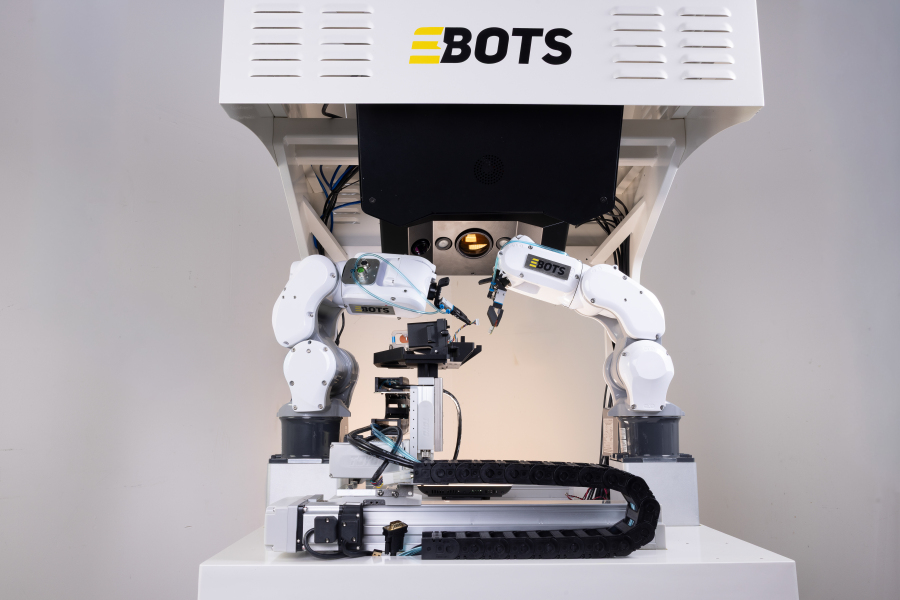
Assembly is the classic manufacturing process of fitting components together. Robots are superstars here because of their speed, precision, and tireless nature. They handle tasks like part insertion, fastening, and joining with unwavering consistency. By automating assembly, companies achieve faster cycle times, higher quality, and lower costs. For manufacturers looking to overcome the hurdles of manual assembly, exploring advanced dual arm systems is a great first step. Learn how Ebots tackles precision assembly.
Electronics Assembly and Testing
The electronics industry moves at lightning speed, and automation is the only way to keep up. Collaborative robot applications in this sector include placing tiny components onto circuit boards (PCBs), soldering connections, and assembling devices. Pick and place robots can mount thousands of components per hour, a feat impossible for humans. After assembly, automated systems test each unit for functionality, using machine vision to catch subtle defects with up to 99.9% accuracy.
Screwdriving
Automated screwdriving is a cornerstone of modern assembly. A robot can drive every screw to the exact specified torque, eliminating the risk of loose or overtightened fasteners that can lead to product failure. This level of error proofing is critical in automotive and medical device manufacturing. By ensuring every fastener is perfect, companies have reduced defect rates from one percent down to virtually zero.
Soldering
Soldering creates the vital electrical connections inside electronic devices. While manual soldering requires immense skill, it can be inconsistent over long shifts. Automated and robotic soldering provides precise control over temperature, timing, and solder amount for every joint. This results in highly reliable connections with minimal defects, which is essential for mass producing the dependable electronics we use every day.
Welding
Welding was one of the very first industrial robot applications, and for good reason. Robotic welding is faster, more consistent, and much safer than manual methods. Robots lay down perfect seams or perform spot welds with incredible repeatability, leading to stronger and higher quality joints. One advanced system was able to reduce weld porosity defects by 58%. By handing this hazardous job to a robot, companies protect workers from intense heat, UV light, and dangerous fumes. For a practical playbook on getting started, see cobot welding benefits, costs, ROI, and how to start.
Streamlining Your Workflow: Material Handling and Logistics
Getting the right part to the right place at the right time is the lifeblood of any factory. Collaborative robot applications in material handling remove bottlenecks and keep production flowing smoothly.
Material Handling
Material handling is a broad category that covers moving parts and materials within a facility. This includes transferring items between conveyors, sorting products, and feeding machines. Historically, handling operations have been the largest application for industrial robots worldwide. They act as the mechanical muscle of the factory, lifting heavy components or moving goods 24/7 without fatigue.
Pick and Place
Pick and place is exactly what it sounds like: picking up an object and putting it somewhere else. It’s one of the most common collaborative robot applications, prized for its speed and accuracy. High speed delta robots, for example, can perform up to 200 picks per minute, sorting and packing small items on a production line. This boosts throughput dramatically while freeing humans from mind numbing repetition.
Bin Picking
Random bin picking has long been called a “holy grail” of robotics. It involves a robot identifying and grasping jumbled parts from a container, a task that requires advanced 3D vision and AI. While challenging, modern systems are making it a reality on factory floors. This technology is automating one of the last major manual handling tasks, allowing robots to feed parts directly from bulk storage into machines.
Machine Tending
Machine tending involves loading raw materials into a machine (like a CNC or injection molding machine) and unloading finished parts. It’s a dull, repetitive, and often unsafe job that is difficult to staff. Robots are the perfect solution, keeping machines running at full capacity around the clock without breaks or ergonomic strain. In fact, machine tending is now the largest application of collaborative robots, a testament to its effectiveness. See examples of advanced automation in manufacturing facilities.
End of Line Excellence: Packaging and Palletizing Applications
Once a product is made, it needs to be packaged and prepared for shipment. These end of line collaborative robot applications ensure goods are sent out quickly, correctly, and safely.
Packaging
Robotic packaging systems handle everything from wrapping and boxing to labeling products for sale. They are incredibly fast and uniform, using different types of robots for specific tasks. For instance, delta robots can pick and place lightweight food items into trays, while other robots can neatly pack boxes for shipment. This level of automation helps companies meet tight deadlines and high consumer demand.
Food and Beverage Packaging
In the food and beverage industry, hygiene is everything. Robots used for these packaging applications are specially designed with washdown ready surfaces and food grade materials to prevent contamination. They handle tasks like sorting produce, bottling drinks, and packing meat with minimal human contact, enhancing food safety. The adoption of these robots surged by 56% in North American food companies in 2020 as businesses sought to maintain output during the pandemic.
Pharmaceutical Packaging and Handling
Similar to the food industry, pharmaceutical packaging requires absolute precision and sterility. Collaborative robot applications in this field handle sensitive vials, blister packs, and medical devices with extreme care. They ensure accurate counts, proper sealing, and complete traceability for every package, which is critical for patient safety and regulatory compliance. Robots can perform these delicate tasks inside sterile environments, reducing the risk of contamination.
Palletizing
Palletizing is the process of stacking boxes or bags onto a pallet for shipping. Manually, this is back breaking work. Robotic palletizers, however, can lift heavy loads and stack them in precise, stable patterns all day long. The world’s fastest palletizing robot can perform up to 2,190 cycles per hour. Automating this task has drastically reduced worker back injuries and their associated costs. For planning your end-of-line roadmap, consult our industrial cobots 2025 guide to costs, safety, and use cases.
Achieving the Perfect Finish: Surface Treatment and Material Removal
The final look and feel of a product often comes down to its finish. These collaborative robot applications deliver flawless surfaces with a consistency that is difficult to achieve by hand.
Finishing
Finishing is a broad term for processes that refine a product’s surface, such as grinding, sanding, and polishing. Robots excel here because they can apply steady pressure and follow exact paths every time. A robotic finishing system can often match or even surpass the quality of a skilled human artisan, all while working faster and longer.
Material Removal
Material removal involves cutting away excess material from a workpiece using processes like drilling, milling, or routing. Robots offer incredible flexibility, as they can be programmed to cut complex shapes on large or awkwardly shaped parts. This is especially useful in the aerospace and automotive industries for trimming composite panels or plastic components with precision.
Deburring
After a part is machined, it often has small, sharp fragments called burrs along its edges. Robotic deburring uses specialized tools to remove these imperfections, ensuring part quality and safety. Unlike manual deburring, which can vary, a robot applies the same pressure and motion every cycle for a perfectly uniform edge finish.
Sanding
Manual sanding is dusty, tedious, and physically demanding. Robotic sanding automates this chore, producing a consistently smooth surface every time. A manufacturer of wooden shutters improved their production time by over 80% after implementing a robotic sander. Better yet, robotic systems with vacuum attachments can capture up to 95% of sanding dust, creating a much cleaner and safer work environment.
Polishing
Polishing is used to create a smooth, shiny surface on materials like metal or plastic. Robotic polishing systems use force controlled arms to mimic the gentle, consistent motions of a skilled polisher. They can produce a uniform, mirror like finish that is free of the inconsistencies that can arise from human fatigue.
Precision Dispensing: Adhesives and Sealing
Many products rely on adhesives or sealants to hold them together or protect them from the elements. Robotic dispensing ensures these materials are applied perfectly every time.
Adhesive Dispensing
Automated adhesive dispensing involves the precise application of glues. Robots lay down a consistent bead or droplet of adhesive to join parts, resulting in less waste and stronger bonds than manual gluing. In automotive manufacturing, robots apply a uniform bead of adhesive to windshields, ensuring a perfect seal.
Sealing
Sealing is a specific type of dispensing focused on creating a barrier against moisture, air, or dust. Robots apply sealants to car bodies, window frames, and electronics enclosures with high precision. This guarantees a continuous, even bead that prevents leaks and improves product durability and reliability.
Specialized Collaborative Robot Applications for High Tech Industries
Beyond the traditional factory floor, collaborative robots are making a significant impact in labs and quality control departments, where precision is not just preferred, it’s required.
Quality Inspection
Manual quality inspection can be slow, and human inspectors can miss subtle flaws. Automated inspection, often using machine vision, is a game changer. An automated system can inspect 2,000 to 3,000 items per hour, compared to a human’s 50 to 100. These systems can achieve 99.9% accuracy, catching microscopic defects that the human eye might miss, ensuring only perfect products reach the customer. If your production line demands the highest quality, you need automation. Discover how Ebots achieves 99.95%+ yields with integrated vision.
Laboratory Sample Handling
In high throughput labs, robots are essential for managing thousands of samples daily. They automate repetitive tasks like moving test tubes, pipetting liquids, and loading analytical instruments. This eliminates human error and dramatically increases speed. One biotech lab automated a cell culture process and cut the time required from 6 hours down to just 70 minutes.
By understanding these diverse collaborative robot applications, businesses can identify powerful opportunities to enhance their operations. This technology empowers your workforce, freeing people from dangerous and monotonous jobs to focus on more valuable, creative tasks.
Ready to see how these collaborative robot applications can revolutionize your factory? Contact Ebots to explore how AI and dual arm dexterity can elevate your production to new heights.
Frequently Asked Questions about Collaborative Robot Applications
What are the most common collaborative robot applications?
The most popular collaborative robot applications include machine tending, pick and place, quality inspection, assembly, and palletizing. These tasks are ideal for cobots because they are highly repetitive and often require working in close proximity to human employees.
How do collaborative robots improve workplace safety?
Cobots improve safety by taking over ergonomically challenging and hazardous jobs. This includes heavy lifting (palletizing), working with dangerous machinery (machine tending), and exposure to fumes or dust (welding, sanding). Their built in safety sensors also allow them to slow down or stop if they make contact with a person.
Are collaborative robots difficult to program?
No, most modern collaborative robots are designed for ease of use. Many can be programmed through simple, intuitive interfaces or even by physically guiding the robot arm through the desired motions (a process called hand guiding). This allows operators with minimal programming experience to deploy and reconfigure them quickly.
Can small businesses benefit from collaborative robot applications?
Absolutely. Collaborative robots are more affordable, flexible, and easier to implement than traditional industrial robots, making them accessible to small and medium sized businesses. They can help smaller companies solve labor shortages, increase productivity, and improve quality to compete with larger operations.
How much do collaborative robots cost?
The cost of a collaborative robot can vary widely based on its size, payload, reach, and the complexity of its end effectors and software. However, they generally have a lower initial cost and a faster return on investment (ROI) compared to traditional industrial robots due to their flexibility and ease of integration.
What is the difference between an industrial robot and a collaborative robot?
The primary difference is safety and design. Traditional industrial robots are powerful and fast, requiring safety cages to protect human workers. Collaborative robots are designed with built in safety features that allow them to work safely alongside humans without cages. They are typically easier to program and more flexible for a variety of tasks.