Content
Essential Capabilities That Separate Advanced Solutions from Conventional Systems
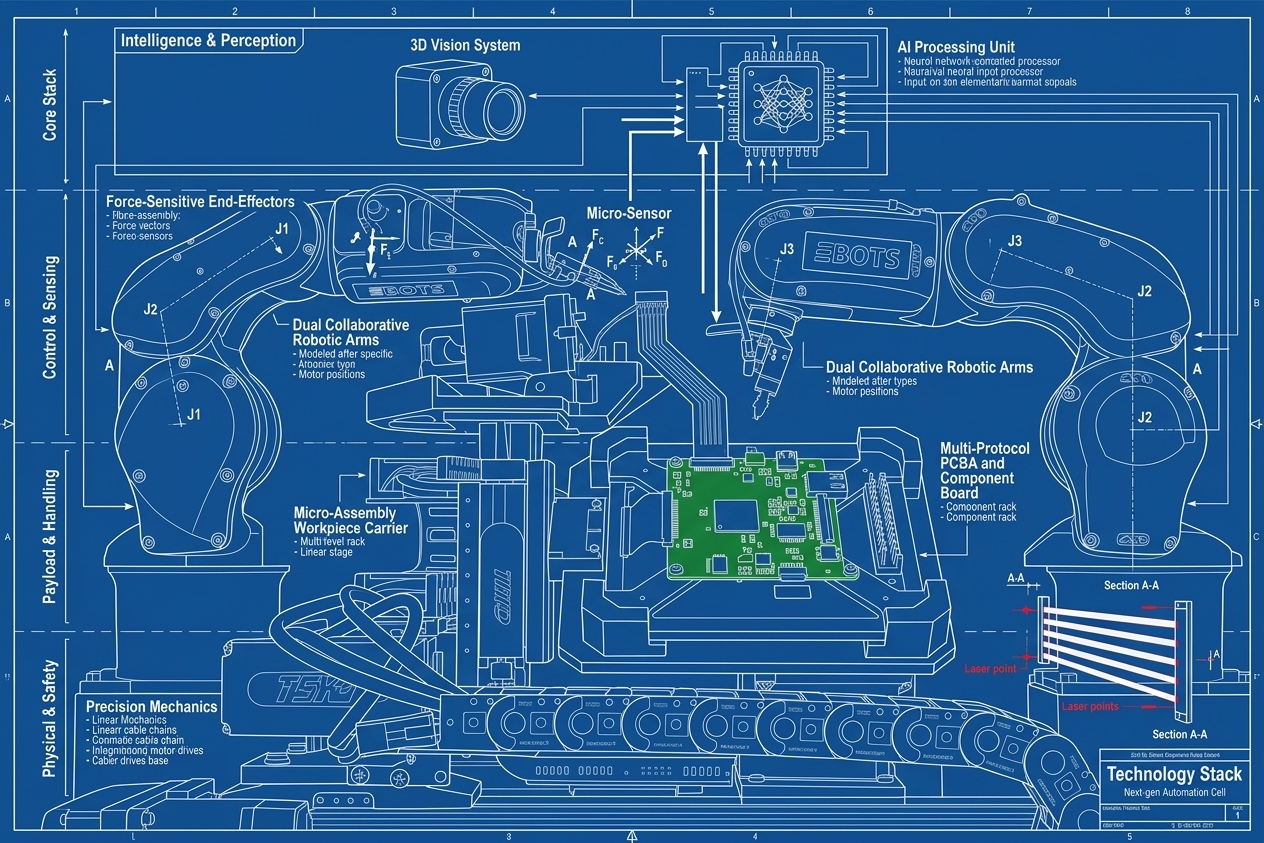
The limitations of traditional pick-and-place automation for flexible circuits are well understood. But what capabilities would a next-generation solution actually require? Understanding this technology blueprint helps manufacturers evaluate emerging automation options and separate genuinely advanced systems from incrementally improved conventional approaches.
Dual-Arm Coordination: Beyond Single-Point Manipulation
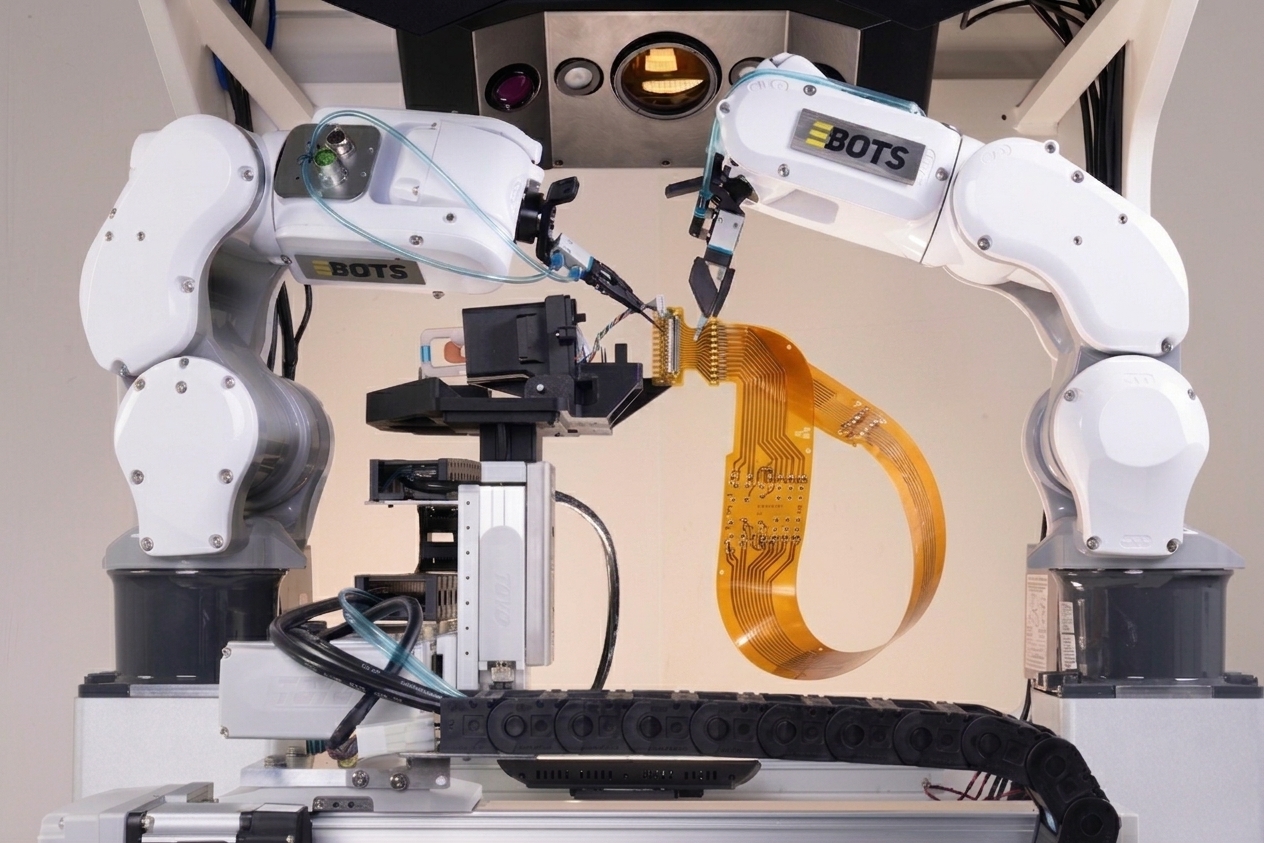
Sophisticated robotic systems need synchronized dual-arm capabilities that replicate the dexterity that skilled assemblers use naturally. This isn’t simply two independent robots working near each other, but rather coordinated manipulation where arms work together on a single task.
One arm needs to secure a delicate substrate with minimal holding force while the other performs precision component placement. The arms need to coordinate with sub-millimeter precision while simultaneously applying differentiated forces. This enables assembly tasks that were previously impossible to automate: routing flexible cables through assemblies, installing snap-fit components requiring simultaneous positioning and pressing, and manipulating reformable materials that don’t behave predictably.
Adaptive Force Control: The Gentle Touch
Flexible substrates demand intelligent force management that goes far beyond fixed pressure settings. Systems must sense substrate characteristics in real-time and dynamically adjust pressure, to ensure that they apply sufficient force for proper component seating without causing substrate damage or delamination.
This requires closed-loop force feedback that operates at millisecond response times and is capable of distinguishing between proper component contact and substrate compression. The system also needs to adapt to material variations across batches, environmental conditions affecting substrate stiffness, and component types requiring different seating forces. Think of it as replicating the tactile sense that an expert assembler would instinctively use.
Advanced 3D Vision: Seeing What 2D Misses
Vision systems are another key component to the solution. Next-generation vision systems must operate in 3D with resolution capabilities in the 5-10 micron range, which is an order of magnitude better than human visual acuity. Additionally, processing speeds need to reach hundreds of frames per second to enable real-time decision-making during placement, rather than relying on after-the-fact inspection.
The system should perform height measurement to verify component seating, substrate flatness mapping that enables placement compensation, solder paste volume measurement before reflow, and defect detection to identify issues that are invisible to 2D imaging. This transforms vision from simple “find the component” functionality to comprehensive quality verification that’s integrated into every step of the process.
Precision That Exceeds Human Capability
Given the delicacy of the material, as well as its relatively small size and thin surface, placement accuracy must achieve ±20-30μm or better. Of course, this positioning precision exceeds skilled human capability by factors of 3X-5X, further proving the requirement for automation. This precision must be repeatable across millions of placements with minimal drift, maintained throughout the system’s operational life through automated calibration verification, and consistently achieved regardless of substrate variations or environmental conditions.
This level of precision enables reliable assembly of the finest-pitch components in production today, as well as headroom for future miniaturization.
AI-Driven Learning and Adaptation
Manufacturing systems should incorporate machine learning that continuously improves process performance without manual intervention. The system learns optimal parameters from production data across product variants, recognizes patterns to predict quality issues before they occur, and automatically adapts to material variations.
Critically, AI should transfer knowledge across product families. While individual products differ, underlying processes share similarities. To dramatically reduce new product introduction cycles, a system that learns placement optimization on product A should be capable of applying those insights to accelerate development of product B.
Rapid Reconfiguration in Minutes, Not Hours
Economic viability for high-mix production demands changeover times that are measured in minutes rather than hours or days. This requires vision-guided operation that eliminates product-specific mechanical fixtures, software-defined processes where changes occur through programming rather than physical retooling, universal component handling to minimize mechanical changes between products, and automated optimization that develop process parameters with minimal human engineering.
When changeover drops from hours to just 15 minutes, the economics of small-batch production transform completely.
Comprehensive Data Integration
Modern manufacturing demands complete digital traceability. Systems need to automatically capture component serial numbers and lot codes, record process parameters for every assembly, log environmental conditions throughout production, and seamlessly integrate with MES/ERP systems for real-time visibility.
This data infrastructure enables regulatory compliance, as well as continuous improvement through analytics that are impossible with manual operations.
The Complete Package
These capabilities don’t exist in isolation. Instead, they must work together as an integrated system: dual-arm coordination without adaptive force control can’t handle delicate substrates safely; precise placement without 3D vision verification can’t guarantee quality; and rapid reconfiguration without AI-driven optimization still requires extensive manual programming.
Manufacturers evaluating automation solutions should demand a demonstration of all of these capabilities working together on their actual products. Partial solutions that excel in one dimension while lacking others will disappoint, thereby delivering some benefits while leaving critical gaps that force continued reliance on manual operations.
The technology blueprint is clear. Now the need is to determine which automation providers are delivering complete solutions rather than simply making incremental improvements to fundamentally limited conventional approaches.
For more information, read the white paper, The Technology Blueprint for Next-Generation Flexible PCB Automation (no registration required).