Content
How Machine Learning Fundamentally Transforms Process Development and Control
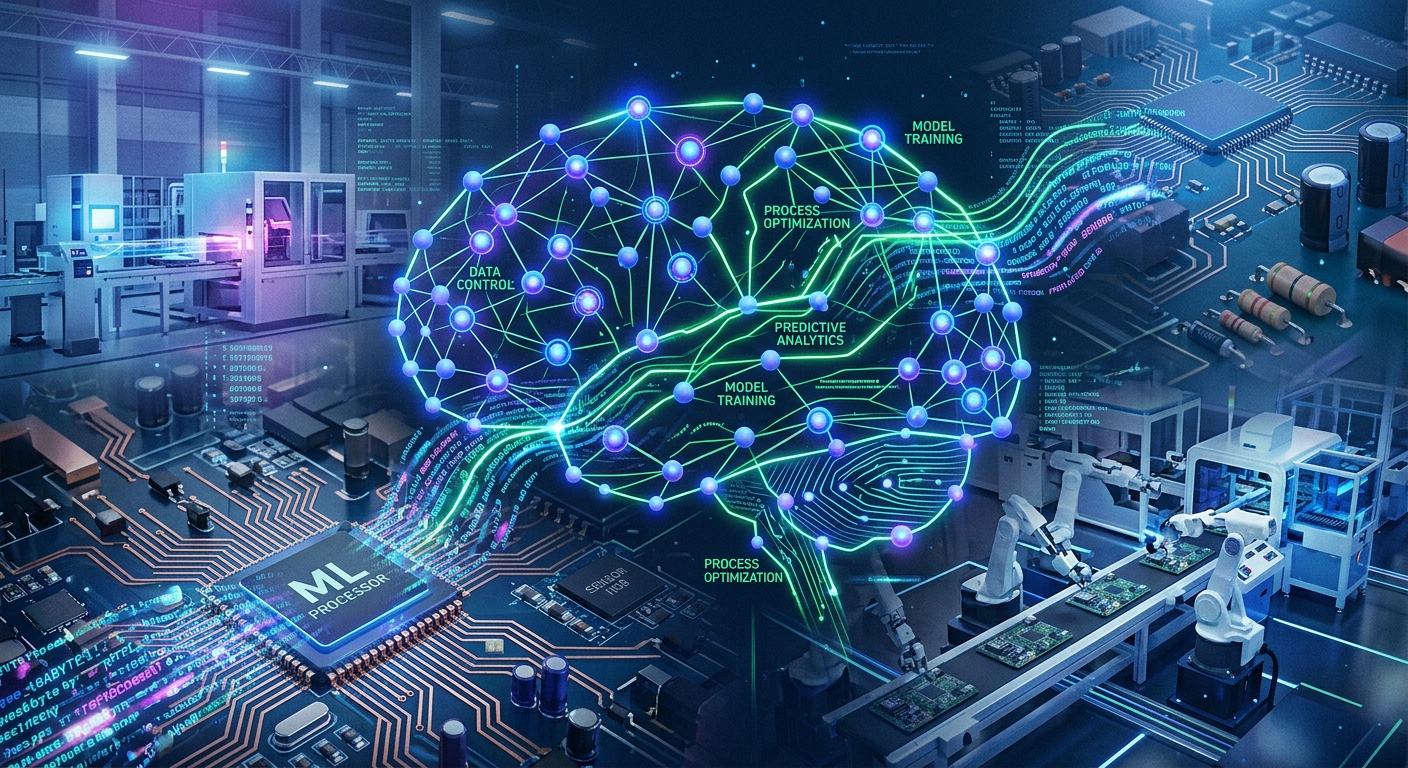
Artificial intelligence has become one of the most overused buzzwords in manufacturing, with vendors claiming “AI-powered” capabilities for everything from simple automation to basic analytics. But beneath the hype, genuine AI applications in precision manufacturing represent something far more significant than incremental improvement. In fact, genuine AI delivers a fundamental transformation in how processes are developed, controlled, and optimized.
Precision manufacturing involves processes with dozens of interacting variables that interact in complex, non-linear ways that defy simple analysis. These variables include placement forces, component temperatures, substrate moisture content, paste viscosity, vision lighting conditions, motion accelerations, environmental factors, and material properties.
Legacy approaches test a handful of parameter combinations, select the best, and then lock them down. But the parameter space contains thousands, or even millions, of possible combinations. Human engineers, constrained by time and resources, are only capable of exploring a tiny fraction of these possibilities and settle for “good enough” rather than taking the time to find what’s truly optimal.
Machine learning algorithms systematically explore multidimensional parameter spaces, testing combinations human engineers would never consider. They discover optimal settings that exceed human intuition, identify subtle correlations between variables that escape human observation, and continuously refine as materials and conditions change.
Rather than detecting defects after they occur, AI enables defects to be predicted before they happen. Machine learning models analyze process data patterns that precede quality issues, such as equipment drift signatures that appear hours before defects occur, material variations that correlate with higher failure rates, and process combinations that produce acceptable immediate results but predict field failures.
This capability fundamentally shifts quality management from reactive inspection and sorting to predictive prevention. Defects that would have occurred simply don’t, because the system recognized risk factors and preventively adjusted processes.
Legacy manufacturing operates on fixed recipes: if conditions match assumptions, the results are acceptable. But when conditions vary, quality suffers. In contrast, AI enables model-based adaptive control that understands the physics governing outcomes, measures actual conditions in real-time, and adjusts parameters dynamically to achieve targets, regardless of variations.
As a result, the system becomes more capable over time rather than degrading. AI learns improved control strategies from every production run and builds process understanding that compounds with operational experience.
A significant AI advantage is the ability to transfer learning between product variants. While products differ, underlying processes share similarities. Machine learning builds process understanding from diverse products and applies lessons learned from one family to accelerate development in others. For example, placement accuracy optimization on product A informs parameter selection for product B, despite different components and layouts. This dramatically reduces new product introduction cycles, enabling the factory to achieve in days what would otherwise require weeks of process development.
Manufacturers embracing AI-driven manufacturing will discover process capabilities that competitors can’t match, including higher yields from optimizations human engineers can’t find, faster development cycles through automated parameter discovery, better adaptability to material and environmental variations, and continuous improvement that compounds over years of operation.
Those treating manufacturing as purely mechanical rather than informational will increasingly fall behind. The gap won’t appear overnight. Rather, it will gradually accumulate as AI-equipped facilities continuously improve while legacy operations remain stagnant.
Separating Real from Hype
How can manufacturers distinguish genuine AI capability from marketing hype? Look for systems that learn and autonomously improve without the need for manual reprogramming, automatically adapt to material and environmental variations, measurably transfer knowledge across product families, and provide data that demonstrates continuous improvement over operational life.
When speaking with a potential vendor, demand demonstration of learning capability, not just automation. Ask how the system performs on month six compared to month one on the same product. Request evidence of knowledge transfer, such as how quickly the system masters product B after optimizing product A.
Real AI delivers measurable, compounding advantages, whereas hype delivers buzzwords. The difference determines whether you’re investing in genuine transformation or just expensive automation with a trendy label.
For more information, read the white paper, Artificial Intelligence in Precision Manufacturing (no registration required).