Content
robotic assembly solutions: high-precision, AI-powered guide
The world of manufacturing is changing fast. For decades, assembly lines relied on human hands for precision work, but that model is running into trouble. High employee turnover, inconsistent quality, and the sheer physical strain of repetitive tasks are pushing factories to find a better way. Enter the age of automation. At their core, robotic assembly solutions use programmable machines to put products together, automating tasks from part insertion to final inspection. These advanced systems are transforming legacy operations.
These aren’t just the clunky, caged robots of the past. Today, more than 4.28 million industrial robots are working in factories around the globe, a number that’s growing every year. Why the boom? Modern robotic assembly solutions offer a powerful answer to the chronic headaches of manual production. They deliver superhuman precision, tireless 24/7 operation, and the flexibility to adapt to new products in minutes, not weeks. This guide breaks down everything you need to know about robotic assembly, from its core benefits and challenges to the amazing technologies making it all possible.
Understanding Robotic Assembly
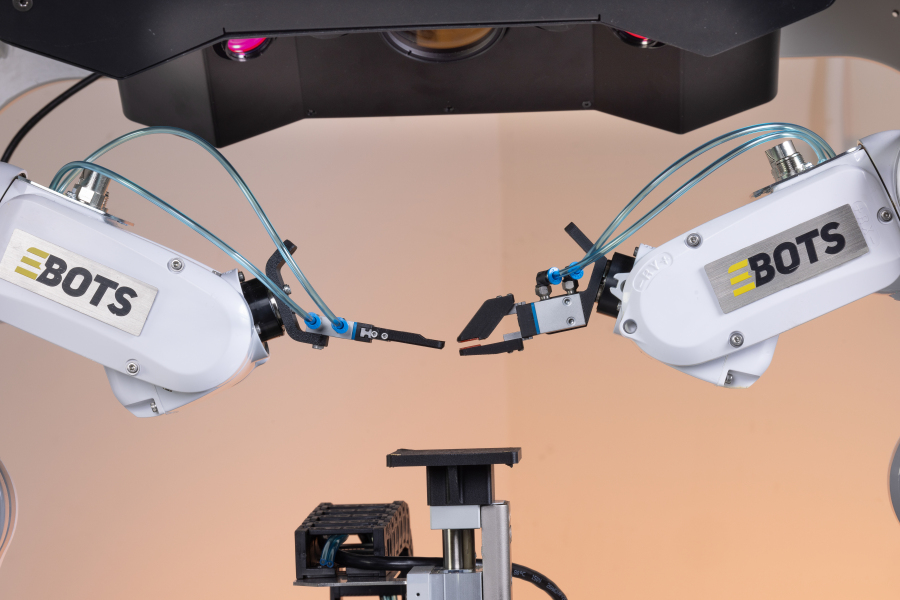
Diving deeper, robotic assembly involves the use of programmable, automated machines (robots) to put products together. Instead of a person manually picking up a part, inserting it, and fastening it, a robotic arm with specialized tooling does the job. These systems can range from a single arm performing a simple task to sophisticated, AI driven dual arm cells that mimic the dexterity of a human worker.
The goal is to streamline production, boost quality, and operate more efficiently. By executing the same precise motions every single time, robots eliminate the natural variability that comes with human labor. This results in higher quality products, less waste, and a safer factory floor, as robots take over the dangerous and ergonomically stressful jobs.
The Advantages of Robotic Assembly Solutions
Switching to automated systems is a big decision, but the benefits are compelling. Manufacturers who adopt robotic assembly solutions see transformative improvements across their operations.
Efficiency and Throughput Improvement
One of the most significant gains is a massive boost in productivity. Robots don’t need breaks, vacations, or sick days; they can operate 24/7. This continuous operation dramatically increases output. For example, some automakers have seen production speeds jump by 30% after introducing assembly robots. By reducing cycle times and running nonstop, these systems maximize throughput, allowing factories to fulfill more orders and scale production to meet rising demand.
Unbeatable Precision
Humans are amazing, but we can’t match a robot for repetitive precision. Industrial robots perform tasks with incredible accuracy, positioning components within extremely tight tolerances every time. Advanced systems, like the dual arm assemblers from Ebots, can achieve micron level precision (around 20 to 40 μm). This consistency means better product quality, a perfect fit for every component, and a significant reduction in defects and material waste. One study even found that companies deploying robots see much lower scrap rates than their manual counterparts.
Next Level Flexibility
Modern robotic assembly solutions are anything but rigid. Unlike single purpose machines, a robotic cell can be quickly reprogrammed to handle different products or tasks. This agility is a game changer for manufacturers dealing with high mix production runs or frequent design updates. Some collaborative robots can even be taught new motions by hand guiding them. Advanced platforms take this even further. For instance, Ebots’ dual‑arm systems can be reconfigured for a new assembly task in about 15 minutes, a process that could take days or weeks with traditional automation.
Significant Cost Reduction
While the initial investment can seem high, robotic assembly solutions deliver substantial long term cost savings. The most obvious is reduced labor cost, as one robot can often do the work of several people across multiple shifts. But the savings go deeper. By improving quality and reducing errors, robots cut down on the costs associated with scrap, rework, and warranty claims. It’s no wonder that 85% of manufacturers name cost reduction as a key reason for adopting robotics. With a rapid return on investment, sometimes in just a few months, the financial case is clear.
Drastic Quality Improvement
Ultimately, robotic assembly leads to better products. By performing every task the exact same way, robots eliminate human error and variability. An automotive manufacturer that automated its welding and assembly processes cut assembly errors by a staggering 25%. Advanced systems can drive quality even higher. On one complex electronics line, an Ebots dual‑arm robot improved assembly accuracy from 85% to an incredible 99%. For more on how precision‑focused automation lifts yield, see our guide to automation in precision manufacturing.
Implementation Challenges to Consider
Adopting robotic assembly solutions can be transformative, but it’s not a simple flip of a switch. Being aware of the hurdles is the first step to overcoming them. See our playbook for advanced automation in manufacturing facilities.
High Initial Cost
The number one barrier for many companies is the upfront capital investment. The cost of the robot, plus controllers, safety systems, and integration services, can be significant. Decision makers need to see a clear return on investment (ROI) to justify the expense. However, as technology becomes more widespread, costs are gradually decreasing. Many providers also offer detailed ROI consultations and financing to make automation more accessible.
Workforce Adaptation
Bringing robots onto the factory floor is a human challenge as much as a technical one. Employees may worry about job security, but the reality is often different. Robots typically take over the dull, dirty, and dangerous jobs, freeing up human workers for more skilled roles like programming, supervision, and quality control. The key is managing this transition through retraining and upskilling. Companies must invest in developing the technical talent needed to operate and maintain these new systems.
Maintenance and Technical Knowledge
A robot is a sophisticated machine that requires ongoing care. Regular maintenance, calibration, and the occasional repair are necessary to keep the system running smoothly. This requires a team with specialized technical knowledge, which can be a challenge for some organizations. Many manufacturers address this by partnering with their robotics provider for training and support. For example, Ebots provides clients with technical training and remote monitoring to help diagnose issues quickly and minimize downtime.
Key Assembly Tasks Perfect for Robots
So, what jobs are best suited for robotic assembly solutions? Robots excel at a wide range of precise, repetitive tasks that are fundamental to manufacturing.
Part Identification and Sortation
Before assembly can begin, parts must be correctly identified and organized. Robots use computer vision systems to recognize components on a conveyor or in a bin. Advanced 3D vision can even identify a specific part from a jumbled pile. Once identified, the robot can sort, orient, and place the parts exactly where they need to go, ensuring the right component is ready for the next step in the process.
Feeding and Picking
This is the classic pick and place operation. A robot picks up a part and places it into an assembly. This is where specialized robots shine. For example, Delta robots, with their spider like design, can perform up to 300 pick and place cycles per minute, making them ideal for high speed electronics or packaging lines. For more complex tasks, vision guided robots can perform “random bin picking,” using 3D cameras to find and grasp parts that are piled randomly in a container.
Fastening and Joining
Connecting parts together is a core assembly function, and robots are masters of it.
Welding: Robotic welding is incredibly common, with robots handling nearly half of all welding operations in the automotive industry.
Screwdriving: Robots can drive screws to the perfect torque every time, preventing issues from under or over tightening.
Dispensing: They can apply precise beads of adhesive or sealant with perfect consistency.
Press Fitting: A force controlled robot can gently press a bearing into a housing with just the right amount of pressure.
Visual Inspection
Quality control is critical, and automated visual inspection is faster and more reliable than the human eye. Using cameras and AI software, robots can inspect products for defects, missing components, or misalignments in real time. These systems can check thousands of parts per minute without getting tired or distracted. For example, BMW uses AI vision to inspect 1,400 vehicles a day at one of its plants.
Common Types of Assembly Robots
Not all robots are created equal. Different designs are suited for different tasks, and choosing the right one is key to a successful implementation of robotic assembly solutions.
Collaborative Robot (Cobot)
A collaborative robot, or cobot, is designed to work safely alongside humans without safety cages. They have built in sensors that stop them if they come into contact with a person. Cobots are typically smaller, easy to program, and great for light assembly or machine tending tasks where they can assist a human worker. They are growing in popularity, accounting for about 10.5% of all industrial robots installed in 2023.
SCARA Robot
SCARA stands for Selective Compliance Assembly Robot Arm. These robots are champions of speed and precision in a horizontal plane. Their design makes them rigid vertically but flexible horizontally, which is perfect for tasks like inserting a peg into a hole without it binding. You’ll often see SCARA robots in electronics assembly, quickly placing small components onto circuit boards.
Delta Robot
Recognizable by its three armed, spider like appearance, the delta robot is built for one thing: incredible speed. Its lightweight arms are all connected to motors in a stationary base, allowing for extremely fast and precise movements. They are the go to choice for high speed pick and place operations in the food, pharmaceutical, and electronics industries.
Six Axis Robot
This is the classic industrial robotic arm and the most common type found in factories today. With six joints (or axes), it has a range of motion similar to a human arm and wrist. This flexibility allows it to perform a huge variety of complex tasks, from welding and painting to intricate assembly. They come in all sizes, from small tabletop models to massive units that can lift car bodies.
The Enabling Technologies Behind Robotic Assembly
Modern robotic assembly solutions are powered by a suite of advanced technologies that give them the ability to see, feel, and interact with the world.
2D and 3D Vision Systems
Vision systems are the eyes of the robot. 2D vision uses cameras to see in a flat plane, perfect for locating parts on a conveyor belt. 3D vision adds depth perception, allowing a robot to see and understand objects in three dimensional space. This is the technology that enables challenging tasks like random bin picking. Combined with AI, vision allows robots to recognize patterns, make decisions, and learn from what they see.
Force Sensing Module
A force sensing module gives a robot a sense of touch. Mounted at the robot’s wrist, this sensor measures the forces and torques being applied. This feedback allows the robot to perform delicate tasks, like gently inserting a connector or tightening a screw to a precise torque, without damaging the parts. It’s what allows a powerful machine to act with finesse.
Smart Sensors and Scanners
Beyond vision and force, an array of smart sensors provides critical data. Proximity sensors detect if a part is present, laser scanners can inspect a weld seam for quality, and barcode scanners can identify every component for full traceability. These sensors act as the nervous system of the assembly cell, ensuring every step happens correctly and reliably.
End of Arm Tooling (EOAT)
The End of Arm Tooling (EOAT) is the robot’s hand. It’s the device that actually interacts with the parts. This could be a mechanical gripper, a vacuum cup, a screwdriver, or a welding torch. Selecting the right EOAT is critical for any application. The market for EOAT is booming, with innovative new designs that are often sensor‑equipped, easy to change, and even inspired by bionics to handle delicate objects with care. For deeper dives and specs, visit our resources.
The Growing Role of Artificial Intelligence in Robotic Assembly
Artificial Intelligence (AI) is transforming robotic assembly solutions from simple programmed machines into intelligent, adaptive partners. See how this comes to life in next‑generation autonomous robots. AI allows robots to learn, make decisions, and handle variability in ways that were previously impossible.
Over 50% of manufacturers are already integrating AI and machine learning into their production processes. AI powered vision systems can identify subtle defects that a human might miss. AI algorithms can optimize a robot’s movements for speed and efficiency. And with “physical AI,” robots can practice a task in a virtual simulation to figure out the best approach before ever touching a real part. This move towards AI is making robotic assembly more robust, flexible, and easier to deploy, especially for complex, high mix production.
The Future of Robotic Assembly
The future of robotic assembly is bright, driven by smarter technology and wider adoption. The global robotics market is projected to grow from around $68 billion today to $165 billion by 2029. We are on the cusp of a new wave of automation.
Here’s what to expect:
Smarter and More Adaptive Robots: AI and advanced sensors will allow robots to handle greater uncertainty and adapt to changes in real time.
Increased Human Robot Collaboration: Cobots will become even more integrated into workflows, working as true partners with their human colleagues.
Easier Programming: Setting up a new task may become as simple as showing the robot a finished product and letting AI figure out the steps.
Sustainability: Robots are being designed to be more energy efficient, with lightweight arms and smart power saving modes to reduce their environmental footprint.
The factory of the future will be a smart factory, where highly connected robotic assembly solutions are a central component of a fully digitalized production ecosystem. Companies that embrace this future, investing in advanced, AI driven platforms, will be the ones who lead the next era of manufacturing. Ready to see how human‑like dexterity and AI can transform your production line? Explore the next generation of robotic assembly solutions here or request a demo.
Frequently Asked Questions
1. What are robotic assembly solutions?
Robotic assembly solutions are automated systems that use industrial robots to perform assembly tasks in a manufacturing process. This includes picking and placing parts, fastening them together, and performing quality inspections to build a final product with high speed, precision, and consistency.
2. What are the main advantages of robotic assembly?
The primary benefits include significantly improved efficiency and throughput from 24/7 operation, enhanced product quality due to high precision and repeatability, greater manufacturing flexibility with quick reprogramming for new tasks, and long term cost reduction through labor savings and reduced waste.
3. Is robotic assembly too expensive for small businesses?
While the initial investment can be high, the cost of robotics has been decreasing. Furthermore, the rapid ROI from increased productivity and quality improvements often makes it a viable and profitable investment even for small to medium sized enterprises. Many providers offer financing and detailed cost benefit analyses.
4. What types of robots are used in assembly?
Common types include versatile Six Axis robots, high speed SCARA and Delta robots for pick and place tasks, and collaborative robots (cobots) designed to work safely alongside humans. The best choice depends on the specific application’s need for speed, payload, reach, and interaction with workers.
5. How is AI changing robotic assembly?
AI is making robots smarter and more adaptive. It enhances machine vision for better part recognition and inspection, optimizes robot movements for efficiency, and allows robots to learn from experience. This enables robots to handle more complex, less structured tasks that previously required human intelligence.
6. What is the biggest challenge when implementing robotic assembly?
The most common challenges are the initial capital cost, the need for workforce adaptation and retraining, and securing the technical expertise required for ongoing maintenance and programming. Proper planning and partnership with a reliable robotics vendor can help overcome these hurdles.
7. Can robots handle delicate or complex assembly tasks?
Yes, absolutely. Modern robotic assembly solutions equipped with advanced technologies like 3D vision and force torque sensors can perform extremely delicate and complex tasks. For example, Ebots’ AI driven, dual arm robots are designed to replicate human dexterity, enabling them to handle intricate processes with micron level precision.
8. What does the future hold for robotic assembly?
The future points toward more intelligent, flexible, and collaborative systems. Expect to see wider adoption, easier programming interfaces (potentially AI driven), and deeper integration into smart factory ecosystems. Robots will become even more essential for manufacturers aiming for high productivity and competitive advantage.