Content
Industrial Automation and Robotics: Benefits, Types & Trends

Welcome to the world of industrial automation and robotics, a field that’s reshaping modern manufacturing right before our eyes. In simple terms, industrial automation and robotics is the use of control systems, computers, and machines to handle industrial processes with minimal human intervention. It’s not just about futuristic machines anymore; it’s about creating smarter, faster, and more reliable factories today. This technology is the engine behind what many call Industry 4.0, the fourth industrial revolution. The global industrial automation market was valued at around $198 billion in 2022 and is projected to soar past $480 billion by 2032, showing just how rapidly businesses are adopting these powerful tools.
This guide will walk you through everything you need to know, from the basic definitions and history to the advanced technologies and real world benefits of embracing industrial automation and robotics.
The Core Concepts: What Are Industrial Automation and Robotics?
While the terms are often used together, it’s helpful to understand what each one means and how they relate to each other.
Defining Industrial Automation
Industrial automation is the use of control systems, computers, and machines to handle processes and machinery in an industrial setting, minimizing the need for human intervention. Think of it as the brain and nervous system of a factory. It’s a broad concept that includes everything from simple temperature controllers to complex software managing an entire production line. The main goals are to boost productivity, improve product quality, and increase safety for workers.
Defining Industrial Robotics
Industrial robotics is a specific branch of industrial automation that involves the use of robots. The official definition of an industrial robot is an “automatically controlled, reprogrammable, multipurpose manipulator programmable in three or more axes”. In simpler terms, it’s a programmable machine, usually a mechanical arm, that can perform physical tasks in a factory. These robots are the hands and feet of the automated factory, handling jobs like welding, assembling, painting, and moving materials.
The Key Difference: Automation vs. Robotics
So, what separates automation from robotics? The easiest way to remember it is that all industrial robotics is a form of automation, but not all automation involves robotics.
Automation is the broader term. It can be purely software based. For example, a script that automatically sends emails or a system that controls the flow of liquids in a plant are both forms of automation without a physical robot. This is often called software automation.
Industrial robotics, on the other hand, always involves a physical, tangible machine that interacts with the real world to perform a task. A robotic arm assembling an iPad is a perfect example of industrial automation that uses robotics.
In short, automation makes processes happen automatically, and sometimes a robot is the best tool for the job.
The Evolution of Smart Factories
Today’s advanced robotics didn’t appear overnight. The journey of industrial automation and robotics has some fascinating historical milestones.
A Brief History of Industrial Automation and Robotics
The seeds of automation were planted centuries ago. One of the earliest examples dates back to 1785, when Oliver Evans created a fully automatic flour mill that could run without any human labor. This was a revolutionary concept for its time.
The 20th century, however, is when things really took off. The modern era of industrial robotics began in 1961 with the introduction of Unimate, the world’s first industrial robot. It started its career at a General Motors plant, where it handled scorching hot metal parts, a dangerous job for any human.
A decade later, in 1970, the first Programmable Logic Controller (PLC) was installed, making it much easier to reprogram factory lines without complex rewiring. The 1970s also saw the invention of the all electric six axis Stanford Arm and the launch of pioneering robotics companies like KUKA and ABB, which brought commercial robots to the market for welding and assembly. This laid the foundation for the sophisticated, interconnected systems we see today.
The Business Case for Industrial Automation and Robotics
Why are so many companies investing heavily in this technology? The benefits are clear, tangible, and transformative for any manufacturing operation.
Driving Significant Cost Reduction
One of the most compelling reasons to adopt industrial automation is a dramatic reduction in costs. By replacing manual labor with machines for repetitive tasks, companies can lower direct labor expenses by up to 40%. Automated systems can run 24/7 without breaks, sick days, or benefits, and they perform tasks at a 60 to 80 percent lower cost than human labor after the initial investment is recovered. It’s no wonder that 59% of companies cite cost savings as a primary driver for their automation investments.
Boosting Productivity and Throughput
Industrial automation is a massive productivity multiplier. Robots work faster and longer than humans without fatigue. On average, a single industrial robot can do the work of about 2.6 human workers in a manufacturing environment. Automating manual processes can save a business roughly 2,000 work hours per year, which is about the same as a full time employee’s annual hours. This surge in productivity allows companies to meet high demand and maintain output even when facing labor shortages.
Achieving Near Perfect Quality
Humans are fantastic at creative problem solving, but we’re not built for perfect repetition. Robots are. Automated systems perform tasks with incredible precision every single time, which drastically improves product quality. For example, an automated machine vision system can improve defect detection accuracy from 92% (for human inspectors) to an incredible 99.7%. This precision, seen in robots like SCARA models with repeatability of just ±0.02 mm, means fewer defects, less wasted material, and a stronger brand reputation. Learn how Ebots masters micron-level manufacturing.
Gaining Unprecedented Flexibility
In the past, automation was often rigid and hard to change. Modern industrial automation and robotics, however, are all about flexibility. Systems built around collaborative robots (cobots) can be reprogrammed for a new task in a matter of hours, not weeks. This agility is crucial for manufacturers that need to handle a high mix of products or adapt to rapidly changing consumer demands.
For instance, while a traditional line might take weeks to retool, some advanced dual arm robotic cells can be reconfigured for a new assembly sequence in about 15 minutes. This level of adaptability is a powerful competitive advantage. If you’re looking to bring this kind of agility to your factory floor, contact the Ebots team for a custom analysis of your workflow.
Improving Workplace Safety
Automation plays a critical role in creating safer work environments. Robots can take over tasks that are dangerous, dirty, or physically demanding. This includes handling hazardous materials, lifting heavy objects, or performing repetitive motions that lead to stress injuries. The first industrial robot, Unimate, was created specifically to protect workers from the dangers of handling molten metal. By removing people from harm’s way, industrial automation has been shown to reduce workplace accidents and workers’ compensation claims significantly.
The Technology Powering Modern Robotics
Today’s automation is powered by a suite of advanced digital technologies that make robots smarter, more connected, and more effective than ever before.
Data Accuracy and Collection: The Foundation of Industry 4.0
Automated systems are incredible data gathering tools. Unlike manual data entry, which has a typical error rate of about 1%, automated data collection is virtually error free. Sensors on machines can stream real time information about temperature, pressure, speed, and quality into a central system. This creates a rich, accurate dataset that provides a live view of the entire production process, forming the backbone of a smart factory.
The Industrial Internet of Things (IIoT) Explained
The Industrial Internet of Things (IIoT) refers to the network of interconnected sensors, instruments, and other devices connected with computers’ industrial applications. This includes manufacturing and energy management. This connectivity allows for a constant flow of data between machines (machine to machine communication) and from machines to central control systems. IIoT is what enables real time monitoring, remote diagnostics, and predictive maintenance, turning a factory into a single, cohesive, intelligent unit.
The Role of AI and Machine Learning in Robotics
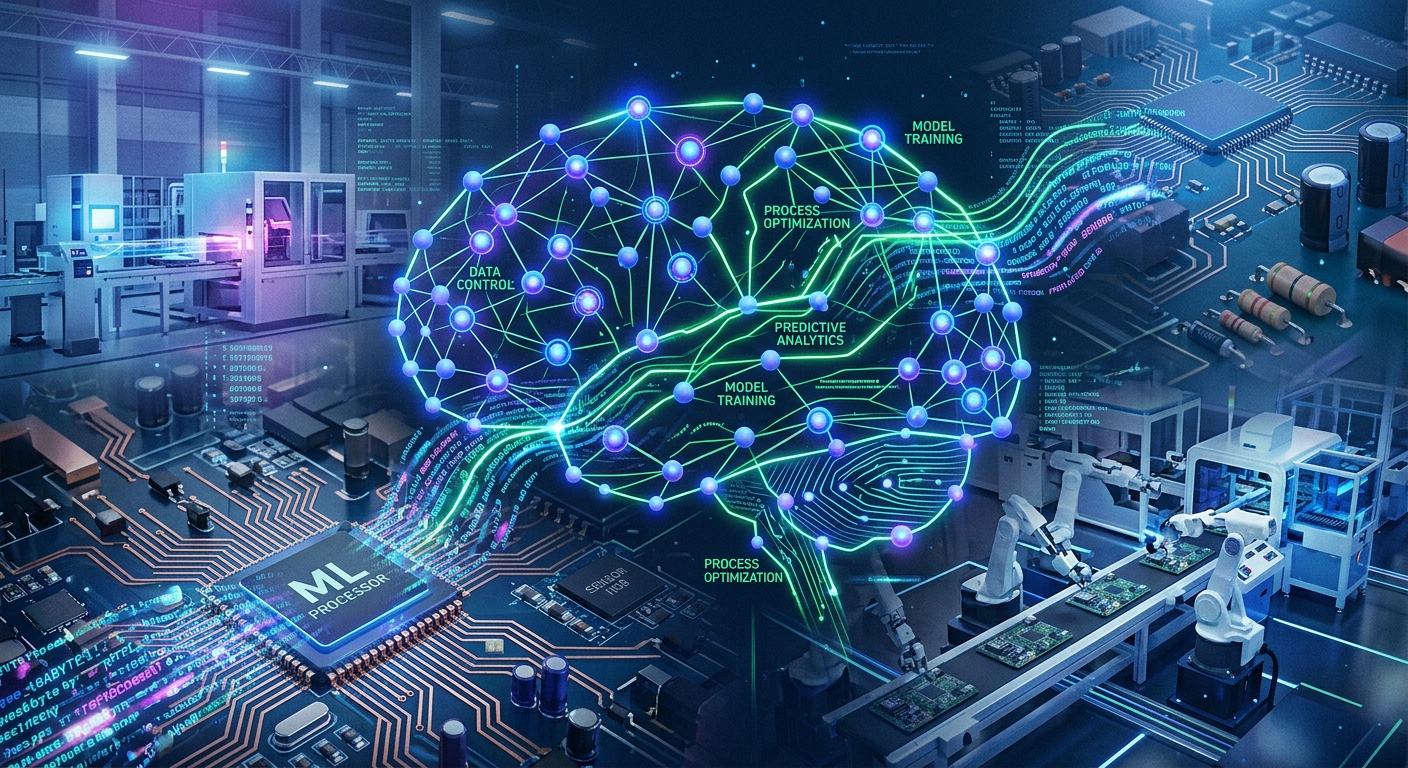
Artificial intelligence (AI) and machine learning (ML) are giving industrial automation and robotics a massive upgrade. Instead of just following a preset program, AI powered robots can perceive their environment, make decisions, and even learn from experience.
AI Vision Systems: Machine learning allows robots to identify and inspect parts with superhuman accuracy, even if the parts are in random positions.
Adaptive Control: AI algorithms can help a robot adjust its movements on the fly to handle variations in parts or conditions.
Predictive Capabilities: ML models can analyze sensor data to predict when a machine will fail, allowing for maintenance before a breakdown occurs.
Using Analytics to Unlock Insights
Collecting data is one thing, but using it is what truly matters. Unfortunately, it’s estimated that around 90% of data generated in manufacturing is never used to gain insights. This is where analytics comes in. By applying data analytics to the information collected from automated systems, companies can:
Optimize Processes: Identify bottlenecks and inefficiencies in the production line.
Enable Predictive Maintenance: Analyzing machine data can reduce unexpected downtime by 20 to 45%.
Improve Quality Control: Track trends in product quality and make proactive adjustments.
A Guide to Common Types of Industrial Robots
Not all robots are created equal. Different designs are optimized for different tasks. Here’s a look at some of the most common types you’ll find in a factory.
Articulated Robots: The Versatile Workhorse
When most people picture an industrial robot, they’re thinking of an articulated robot. These are robotic arms with rotary joints, typically six of them (or six axes), that give them a huge range of motion, similar to a human arm. Their flexibility makes them perfect for a wide variety of tasks, including welding, painting, assembly, and palletizing. You’ll find them everywhere, especially in the automotive industry.
SCARA Robots: The Speed Specialist
SCARA stands for Selective Compliance Assembly Robot Arm. These robots are champions of speed and precision for pick and place and assembly tasks. With four axes of motion, they are incredibly fast for moving small parts on a horizontal plane. They are a common sight in the electronics and semiconductor industries, where they handle delicate components with micrometer level accuracy.
Delta Robots: The High Speed Picker
Known for their distinct spider like appearance, delta (parallel) robots are built for one thing: extreme speed. They use three or four lightweight arms connected to a single platform to pick and package small items at incredible rates, sometimes over 100 picks per minute. They are the go to solution for high throughput applications in the food, pharmaceutical, and electronics industries.
Collaborative Robots (Cobots): The Human Friendly Partner
Collaborative robots, or cobots, are designed to work safely alongside human employees without the need for safety cages. They are equipped with sensors that allow them to stop if they come into contact with a person. Cobots are typically easy to program, flexible, and are becoming incredibly popular for tasks like light assembly, machine tending, and quality inspection. In fact, they are the fastest growing segment of the industrial robotics market.
Mobile Industrial Robots (AMRs and AGVs)
Mobile industrial robots are a category that includes Automated Guided Vehicles (AGVs) and more advanced Autonomous Mobile Robots (AMRs). Instead of being fixed in one place, these robots navigate through factories and warehouses to transport materials. AMRs use sensors like LiDAR and cameras to create their own paths and avoid obstacles, making them highly flexible for modern logistics. Their adoption is surging, with sales of professional service robots growing 37% in 2021 alone.
Cylindrical Robots
Cylindrical robots are an older robot design with a rotary base and at least one linear joint, giving them a cylindrical shaped work envelope. They were historically used for simple pick and place tasks and machine loading. While largely replaced by more flexible articulated and SCARA robots, their design principles can still be found in certain specialized applications.
Core Components That Make Robots Work
Every industrial robot, regardless of type, relies on a few key components to function.
Robot Sensors: The Five Senses of Automation
Sensors are what allow a robot to perceive its environment. They act as the robot’s eyes, ears, and sense of touch. Common types include:
Vision Sensors (Cameras): For object recognition, guidance, and inspection.
Force Torque Sensors: To feel how much force is being applied, crucial for delicate assembly tasks.
Proximity Sensors: To detect when an object is near without physical contact.
Robot Actuators: Providing the Power to Move
Actuators are the muscles of the robot. They are the motors and drives that convert energy (usually electrical) into physical motion. Most modern industrial robots use high precision servo motors that allow for exact control over speed, position, and torque.
Robot Control System: The Brain of the Operation
The control system is the robot’s brain. It consists of computer hardware and software that processes sensor data, executes program instructions, and coordinates the movement of the actuators. This controller is what allows a robot to perform its tasks with precision and repeatability.
Real World Applications and Challenges
Implementing industrial automation and robotics offers huge rewards, but it also comes with its own set of considerations.
Common Industrial Robotics Applications
Industrial robotics is used across a vast range of industries and applications, including:
Welding and Painting: Especially in automotive manufacturing for consistency and safety; see how cobot welding improves quality and ROI.
Assembly: For everything from consumer electronics to medical devices.
Material Handling: Picking, packing, and palletizing products.
Machine Tending: Loading and unloading parts from other machines like CNCs.
Quality Inspection: Using cameras and sensors to check for defects.
Overcoming Implementation Costs and Challenges
The upfront implementation cost of industrial automation can be significant, with a single solution often costing hundreds of thousands of dollars. This includes not just the robot itself but also integration, programming, and safety equipment. However, the return on investment (ROI) is often very strong, with many projects paying for themselves in under two years. Some companies that adopt intelligent automation report an ROI as high as 200%. Key challenges beyond cost include successful integration with existing systems and ongoing maintenance.
The Impact on the Workforce and the Need for Upskilling
A common concern is that industrial automation and robotics will eliminate jobs. While some manual roles are being replaced, automation is also creating new, higher skilled jobs. There is a growing demand for robot technicians, automation engineers, and data analysts. This shift requires a focus on upskilling and retraining the workforce to prepare them for the jobs of the future factory. The goal is not to replace humans, but to augment their capabilities, freeing them from dull, dirty, and dangerous tasks to focus on more valuable work.
The Critical Importance of Industrial Robotics Cybersecurity
As robots become more connected through the IIoT, cybersecurity becomes a critical concern. A compromised robot could lead to production shutdowns, theft of intellectual property, or even create a physical safety hazard. Protecting industrial control systems from cyber threats is essential for any company embracing Industry 4.0. This involves securing networks, controlling access, and regularly monitoring systems for suspicious activity.
The Future of Industrial Automation and Robotics
The future of industrial automation and robotics is incredibly bright and moving fast. Annual robot installations have more than doubled in the last 10 years, and this growth is set to accelerate. We are heading towards a future defined by:
Smarter Robots: AI and machine learning will make robots that can learn, adapt, and work more autonomously.
Human Robot Collaboration: Cobots will become even more common, acting as true partners to human workers.
Democratized Automation: Technology will become more affordable and easier to use, making it accessible to small and medium sized businesses.
The “Factory of the Future” will feature autonomous mobile robots delivering parts, AI optimizing production schedules in real time, and highly flexible robotic cells that can adapt to new products instantly. Companies at the forefront of this wave are already deploying advanced systems that combine human like dexterity with superhuman precision. These next generation robots are proving they can raise assembly accuracy from 85% to over 99%, signaling a new era of manufacturing excellence. To see how these advanced solutions can transform your operations, you can contact Ebots for a consultation and explore the future of manufacturing.
Frequently Asked Questions about Industrial Automation and Robotics
What is the main goal of industrial automation?
The primary goal is to improve manufacturing efficiency, quality, and safety. This is achieved by using technology to increase productivity, reduce errors and waste, lower costs, and remove human workers from hazardous tasks.
Are robots going to take all manufacturing jobs?
While automation is changing the nature of manufacturing work, it’s not expected to eliminate all jobs. It tends to replace repetitive, low skill tasks while creating new demand for higher skilled roles like robot programmers, maintenance technicians, and data scientists. The focus is on upskilling the workforce to collaborate with new technologies.
What’s the difference between a robot and a cobot?
A traditional industrial robot is typically powerful, fast, and operates behind safety fences to protect workers. A collaborative robot, or cobot, is designed with built in safety features that allow it to work directly alongside humans in a shared space without extensive guarding.
How much does an industrial robot cost?
The cost varies widely depending on the type, size, and application. A simple cobot might start in the tens of thousands of dollars, while a complex, fully integrated robotic system for a task like welding or painting can cost hundreds of thousands of dollars. It’s important to consider the total cost of ownership, including integration and maintenance, as well as the potential ROI.
What industries use industrial automation and robotics the most?
The automotive industry has historically been the largest user of industrial robots. However, other industries like electronics, metals and machinery, plastics and chemicals, and food and beverage are all rapidly increasing their adoption of automation and robotics.