Content
Automated Assembly Line: Benefits, Components & ROI
In today’s competitive manufacturing landscape, companies face a constant battle against labor shortages, inconsistent quality, and the relentless pressure to produce more, faster. Legacy production lines that rely heavily on manual work often struggle with high employee turnover, which can be around 40% annually, leading to endless cycles of hiring and training. This instability makes it nearly impossible to maintain consistent output and quality.
The solution? A well-designed automated assembly line. An automated assembly line uses machinery and control systems to perform manufacturing tasks with minimal human help, directly addressing the challenges of inconsistency and labor dependency. This guide explores everything you need to know about transforming your factory floor with automation, from its historical roots to the smart, AI driven systems of tomorrow.
A Brief History of the Automated Assembly Line
The concept of the automated assembly line has been evolving for over a century. The journey began in 1913 when Henry Ford introduced the moving assembly line. This innovation slashed the time to build a Model T from over 12 hours to just 90 minutes, kicking off the era of mass production. For decades, these lines were manual, but technology kept pushing forward.
A major leap came in 1961 when General Motors installed Unimate, the first industrial robot, to handle dangerous welding tasks. The 1970s and 1980s brought programmable logic controllers (PLCs), allowing for more complex and reliable automation. By the 1990s, robots were common, performing tasks with greater precision than ever before.
Today, we are in the era of Industry 4.0, where the modern automated assembly line integrates advanced robotics, AI, and IoT sensors. Factories are now home to over 3 million industrial robots worldwide, a number that continues to grow as companies seek to boost efficiency and quality.
The Powerful Benefits of Assembly Line Automation
Switching from manual labor to an automated assembly line offers transformative advantages that address the core pain points of modern manufacturing.
Higher Throughput and Efficiency: Robots don’t need breaks. An automated line can run 24 hours a day, 7 days a week, often outpacing human workers by two to four times on repetitive tasks. This continuous operation dramatically increases the number of units you can produce.
Greater Precision and Consistency: Automation eliminates the variability that comes with human fatigue and error. A robot can tighten a component to an exact torque value every single time, achieving a level of precision (sometimes within ±0.02 mm) that is beyond human capability. This consistency minimizes defects and boosts your first pass yield. Learn how automation in precision manufacturing pushes tolerances and yield even further.
Reduced Labor Costs and Stronger ROI: While the initial investment can be significant, automation drastically cuts ongoing labor costs. You save on wages, benefits, and the constant expense of recruiting and training new workers. Many companies find that their automation projects deliver a return on investment in just a few years, sometimes even months.
Improved Workplace Safety: Automation excels at handling dangerous, repetitive, or ergonomically stressful jobs. Robots can work with toxic materials, high temperatures, or heavy parts without any risk of injury. This allows you to move your human workers into safer, more valuable roles like supervision and quality control.
Flexibility and Scalability: Modern automation is surprisingly flexible. A programmable automated assembly line can be quickly reconfigured to handle new product models. Need to increase output? Adding another robotic cell is far easier than hiring and training an entire new shift of workers.
Powerful Data Collection: Automated systems generate a constant stream of data on cycle times, sensor readings, and quality checks. This information is a goldmine for process improvement, allowing you to identify inefficiencies and perform predictive maintenance before a machine fails.
Choosing Your Automation Strategy
Not all automation is created equal. The right approach depends on your production volume, product variety, and budget. The first decision is choosing the right level of automation. For a deeper dive, see our guide to advanced automation in manufacturing facilities.
Fully Automated vs. Semi Automated Lines
Deciding on the right level of automation is a critical strategic choice.
A fully automated assembly line is a system where machines handle nearly every task, from loading raw materials to inspecting finished products. Human involvement is limited to supervision, maintenance, and programming. These “lights out” systems are perfect for high volume, stable production, offering maximum speed and consistency.
A semi automated assembly line is a hybrid model where humans and machines work together. Machines might perform the repetitive or physically demanding tasks, while humans handle jobs that require dexterity, critical judgment, or flexibility. This approach offers a great balance of efficiency and adaptability, often with a lower initial investment. It’s an excellent choice for moderate volumes or products with frequent design changes.
Types of Automation Systems
Once you know your desired level of automation, you can choose the type of system that fits best.
Fixed Automation
Also known as hard automation, this is a system designed to perform one specific task repeatedly at a very high speed. The equipment is custom built for a single product and is not easily changed.
Best for: Mass production of a single, stable product.
Pros: Extremely high throughput and low cost per unit.
Cons: Very inflexible. A product design change could require a complete retooling.
Programmable Automation
Here, the equipment is controlled by software and can be reprogrammed to handle different products. This is the workhorse of modern manufacturing, ideal for producing goods in batches.
Best for: Medium volume production with multiple product variations.
Pros: Balances efficiency with the flexibility to handle changes.
Cons: Changeovers require downtime for reprogramming and retooling.
Flexible Automation
This is the most advanced form of automation, where a system can handle a variety of products with minimal or zero changeover time. Using advanced sensors and software, the line can automatically adjust to different product types as they come through.
Best for: High mix, variable volume production or mass customization.
Pros: Incredible agility and almost no downtime between different products.
Cons: Highest initial cost and complexity.
Key Components of an Automated Assembly Line
An automated assembly line is a symphony of interconnected parts working together. Here are the core components that make it all happen.
Industrial Robots
These are the primary workhorses of automation. An industrial robot is a programmable arm that can perform tasks like welding, painting, assembly, and material handling. Common types include:
Articulated Robots: Highly flexible arms with multiple joints, similar to a human arm.
SCARA Robots: Fast and precise, ideal for pick and place operations.
Delta Robots: Extremely fast for picking up lightweight items on moving conveyors.
Pick and Place Robots: A general category for robots designed for rapid material handling, often a SCARA or Delta robot.
Palletizers: Robots specifically designed to stack finished goods onto pallets for shipping.
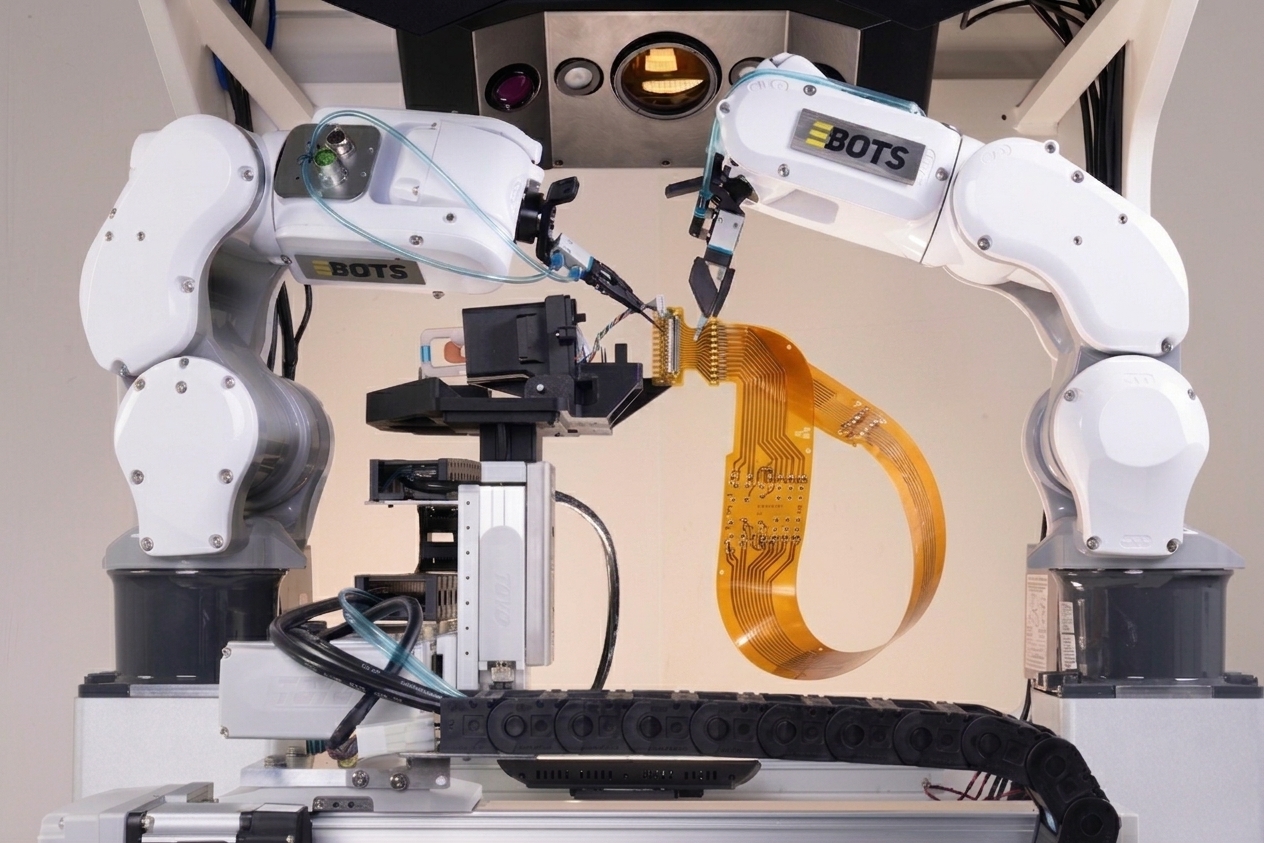
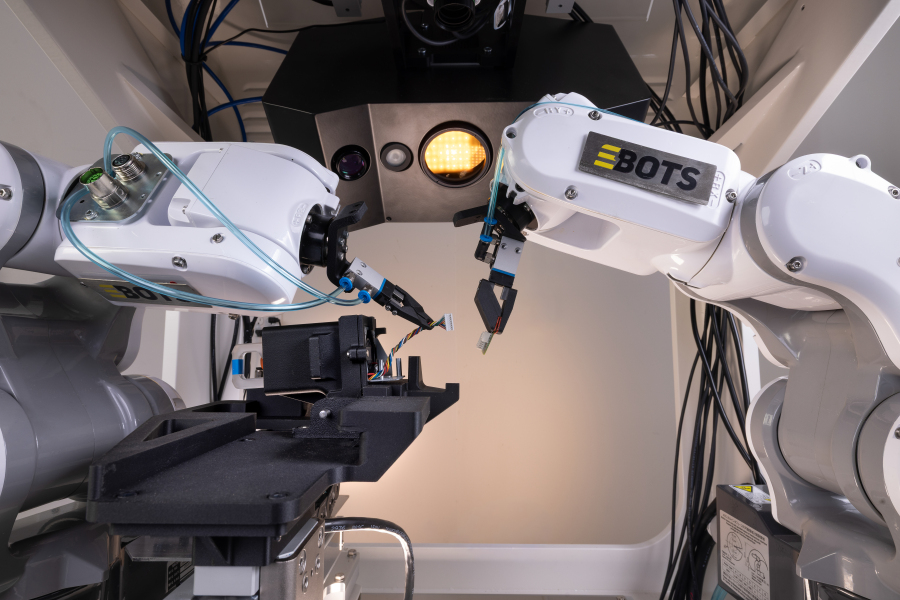
Modern solutions are pushing the boundaries of what robots can do. For example, some systems use dual arms with AI and 3D vision to replicate the dexterity of a skilled human worker, enabling intricate assembly of complex products. For companies struggling with precision tasks, these advanced robotics platforms offer a transformative solution.
Control System and PLCs
The control system is the brain of the automated assembly line. It coordinates all the actions of the robots, conveyors, and sensors. At its heart is often a Programmable Logic Controller (PLC), a rugged industrial computer that executes a program to run the line’s sequence of operations. PLC programming dictates the timing, logic, and safety interlocks that ensure everything runs smoothly and safely.
Sensors and Vision Systems
Sensors are the eyes and ears of the automated line. They detect the presence of parts, verify positions, and provide feedback to the control system. Vision systems use cameras and image processing software to guide robots, inspect for defects, and read barcodes for traceability.
Conveyor Systems and Actuators
Conveyors are the arteries of the factory, moving parts and products between stations. Actuators are the muscles, converting electrical or pneumatic signals into physical motion. This includes electric motors that drive conveyors, pneumatic cylinders that push parts, and grippers that pick up objects.
Human Machine Interface (HMI)
The HMI is the dashboard that allows human operators to interact with the line. Typically a touchscreen, it displays real time data, alarms, and production counts, and allows operators to start, stop, or adjust the process.
IoT and Industry 4.0 Integration
This involves connecting every machine and sensor to a network, allowing them to share data. This “smart factory” approach enables powerful capabilities like predictive maintenance, real time performance dashboards, and self optimizing processes. An automated assembly line integrated with IoT can report its own health and efficiency, helping you make smarter, data driven decisions. Explore the Ebots AI-driven robotic cell platform that integrates natively with Industry 4.0 stacks.
Specialized Systems on a Modern Line
Beyond the core components, many automated lines feature specialized stations for specific tasks.
High Throughput Automation: These are systems, often using fixed automation, designed for maximum speed in industries like food and beverage or consumer goods.
Welding Systems: Robotic welding cells are standard in automotive and metal fabrication, providing consistent and high quality welds in a safe, enclosed environment.
Inspection and Testing Systems: These stations automatically check for quality. An inspection system might use cameras to look for cosmetic defects, while a testing system could check for electrical continuity or functionality. A leak detection system, for example, might pressurize a part and monitor for pressure drops.
Marking and Traceability Systems: These systems automatically mark each product with a unique serial number or barcode. This allows for complete traceability, so if a defect is found later, you can pinpoint exactly when and how that specific unit was made.
Planning and Implementing Your Automated Assembly Line
A successful automation project requires careful planning. Here are the key considerations and best practices to follow.
Challenges and Best Practices
Implementing automation isn’t without its challenges. Common hurdles include the high initial investment, the technical complexity of integrating different systems, and the need to train your workforce.
Best practices to overcome these include:
Conducting a thorough ROI analysis to justify the cost.
Starting with a pilot project to prove the concept and build momentum.
Working with an experienced integration partner.
Involving your workforce early and investing in training.
Many companies find that addressing the chronic costs of labor turnover and inconsistent quality makes the business case for automation compelling. A partner specializing in automation can help you navigate these challenges and ensure a smooth rollout. Explore how integrated automation solutions can overcome common manufacturing hurdles.
Design and Budgeting
Before you buy any equipment, you need a solid plan. Get templates and checklists in our resources library.
Design for Automation (DFA): Don’t just automate your existing manual process. Reevaluate and simplify it. Sometimes, a small change to a product’s design, like adding a notch for a robot to grip, can make automation much simpler and more reliable. Consider the design complexity and what tolerances your automated system can realistically hold.
Budget Planning: Automation is a significant investment. Your budget should account for not just the hardware, but also software, integration services, training, and a contingency for unexpected costs.
Scaling and Volume: Think about your future needs. Will your production volume grow? Choose a modular and scalable system that allows you to easily add capacity later without a complete overhaul.
Selecting Equipment and Partners
Choosing the right hardware and the right team is crucial.
Equipment Selection: Your choice of robots, conveyors, and sensors should be driven by your specific needs for speed, precision, and flexibility. Don’t overspend on capabilities you don’t need, but also don’t choose the cheapest option if it compromises reliability.
Partner Selection: Unless you have a large in house automation team, you will likely work with a systems integrator or an automation provider. Look for a partner with proven experience in your industry. A good partner doesn’t just sell you machines; they work with you to design a solution that solves your specific problems and supports you long after installation. Learn about Ebots’ integration expertise.
Automation and Lean Manufacturing
Finally, it’s important to see automation through the lens of lean manufacturing principles. An automated assembly line is a powerful tool for eliminating waste (muda). It reduces defects, minimizes waiting time between processes, and optimizes motion. By creating a consistent and predictable flow, automation helps you build a truly lean operation.
Frequently Asked Questions (FAQ)
1. What is the first step in creating an automated assembly line?
The first step is a thorough process analysis. Identify the bottlenecks, repetitive tasks, and quality issues in your current manual process. This will help you determine which areas will benefit most from automation.
2. How much does an automated assembly line cost?
Costs vary widely depending on the complexity, from tens of thousands of dollars for a single robotic cell to millions for a fully integrated line. It’s essential to perform a detailed ROI calculation that considers savings from labor, increased throughput, and improved quality.
3. Can I automate a process with many different product variations?
Yes. Flexible automation systems, which use programmable robots and quick change tooling, are specifically designed for high mix, variable volume production. This allows you to handle customization without significant downtime.
4. How does an automated assembly line improve quality?
Automation improves quality by eliminating human error and variability. Machines perform tasks with the same precision and force every time, leading to more consistent products and a higher first pass yield.
5. Do I need special skills to operate an automated assembly line?
Your team will need training. Operators will learn to use the HMI to run the line and handle basic alarms. Your maintenance staff will need training on the new robotic and control systems. Many automation providers offer comprehensive training as part of the implementation.
6. What is “lights out” manufacturing?
“Lights out” refers to a fully automated factory or automated assembly line that can run with no human presence on the floor, allowing production to continue around the clock.
7. How do I choose between a semi automated and a fully automated line?
Choose based on your volume, budget, and process complexity. If you have extremely high, stable volume, full automation may be best. If your volume is moderate, your budget is limited, or some tasks require human dexterity, a semi automated approach is often the ideal solution.
8. What kind of ROI can I expect from automation?
ROI depends on many factors, but it’s often driven by labor savings, scrap reduction, and increased output. For precision assembly, replacing a manual station can eliminate over $75,000 in annual costs, leading to a payback period measured in months, not years. Discover your potential ROI with a custom consultation.