Content
cobotics: Definition, Safety, ROI & Real-World Uses
Welcome to the world of cobotics, a field that’s reshaping modern manufacturing and logistics. Short for collaborative robotics, this technology is all about creating robots, or cobots, that can work safely and effectively right alongside people. Instead of being locked away in cages like traditional industrial robots, cobots are designed to be teammates, blending the best of human ingenuity with robotic precision.
This guide will walk you through everything you need to know about cobotics, from the core concepts and safety standards to real world applications and the compelling business case for adoption. For a deeper dive into factory outcomes, explore automation in precision manufacturing.
Cobotics vs. Traditional Robotics: What’s the Real Difference?
While both fall under the umbrella of automation, cobotics represents a specific philosophy focused on partnership. Traditional industrial robots are powerhouses of speed and strength, but they operate in isolation for safety reasons. Cobots, on the other hand, are built for interaction.
Here’s a breakdown of the key differences:
Work Environment: Traditional robots work in caged off, human free zones. Cobots are designed to share a workspace with people, operating without physical barriers. This allows them to work hand in hand with human operators.
Speed and Power: To ensure safety, cobots operate with limited force and speed. They can automatically slow or stop if they make contact with a person, preventing injury. A cobot’s tool speed is often capped around 250 mm per second when a human is nearby. Industrial robots are much faster and stronger but would be dangerous in an open environment.
Design and Mobility: Cobots are typically lightweight, flexible, and easy to move. Many can be mounted on carts and relocated to different workstations as production needs change. Traditional robots are usually large, stationary machines dedicated to a single task.
Safety Features: Industrial robots rely on external safety measures like fences and scanners. Cobots have safety built in, with features like force limiting joints, rounded surfaces, and advanced sensors that allow them to work safely around people.
A Brief History of Cobotics
The field of cobotics is relatively young. The concept and the term cobot emerged in the mid 1990s from research at Northwestern University.
In 1996, professors J. Edward Colgate and Michael Peshkin developed the first cobot prototypes, which they called “programmable constraint machines”. These early devices were passive, designed to guide a human worker’s movements with computer assistance. The research was partly funded by a General Motors initiative aimed at making robots safe enough to work directly with factory employees.
The technology took a major leap forward in 2008 when the Danish company Universal Robots sold the first commercial cobot, the UR5. This release proved there was a market for user friendly, fenceless robot arms. By 2016, collaborative robots were the fastest growing segment of industrial robotics, with around 50% year on year growth at the time. This success spurred other major robotics companies like ABB and Fanuc to develop their own collaborative models, cementing cobotics as a key pillar of modern automation.
The Heart of Cobotics: Human Robot Collaboration
Human Robot Collaboration (HRC) is the practical application of cobotics. It involves designing workflows where people and robots can team up, each contributing their unique strengths. Humans bring adaptability, creativity, and complex problem solving skills, while robots offer tireless strength, precision, and consistency.
This synergy is incredibly effective. Studies have shown that human robot teams can be up to 85% more productive than either humans or robots working alone. Instead of replacing workers, this approach enhances their capabilities, freeing them from dull, dangerous, and physically taxing tasks to focus on higher value work.
The Four Levels of Collaboration
Not all HRC is the same. The International Federation of Robotics (IFR) outlines four distinct levels of collaboration:
Coexistence: The human and robot work in the same general area without a fence but don’t share a workspace at the same time. Their tasks are separate.
Sequential Collaboration: The human and robot share a workspace but take turns. For example, a cobot fills a box, then stops, and a human steps in to add a final item.
Cooperation: The human and robot work on the same part at the same time. A classic example is a cobot holding a heavy component in place while a worker fastens it.
Responsive Collaboration: This is the most advanced level, where the robot actively responds to the human’s movements in real time, adapting its actions based on its partner’s lead.
Most industrial applications today fall into the coexistence or sequential collaboration categories, but as technology advances, more cooperative workflows are emerging.
Safety: The Cornerstone of Cobotics
The ability for robots and humans to work together rests entirely on a foundation of safety. Cobotics achieves this through a combination of inherent design features, industry standards, and rigorous risk assessment.
Built in Cobot Safety Features
Power and Force Limiting: Cobots are engineered to limit the force their joints can exert. If a cobot arm encounters an obstacle (like a person), it immediately stops or reverses. This is guided by standards like ISO/TS 15066, which specifies maximum safe force and pressure levels for 29 different body regions to prevent pain or injury.
Speed Limiting and Soft Stops: Cobots move at controlled speeds, allowing them to stop quickly. They are designed with smooth, rounded surfaces and lightweight materials to minimize impact in case of a collision. Some models, like FANUC’s green CR series robots, even feature a soft rubber skin for extra cushioning.
Advanced Sensors and Vision: Many cobots use cameras and sensors to create virtual safety zones. They can automatically slow down as a person approaches and stop completely if they get too close.
Key Cobot Safety Standards
A framework of international standards governs the design and deployment of collaborative robots, ensuring they are safe for HRC. See how these practices translate on the shop floor with advanced automation in manufacturing facilities.
ISO 10218 (Parts 1 & 2): This is the foundational safety standard for all industrial robots. It introduced the initial requirements for collaborative operation, paving the way for fenceless robot systems.
ISO/TS 15066:2016: This is the key technical specification dedicated to collaborative robot safety. Published in 2016, it provides detailed guidelines on force limits, speed monitoring, and the design of collaborative workspaces. It’s the essential reference for anyone implementing a cobot system.
Why a Risk Assessment is Non Negotiable
Even with a certified “safe” cobot, a thorough risk assessment is required for every application. Safety isn’t just about the robot itself; it’s about the entire system, including the tool it’s holding (an end effector), the part it’s handling, and the environment it’s in. A cobot arm is safe, but a cobot arm wielding a sharp tool introduces new hazards that must be addressed. The risk assessment process involves identifying potential hazards, evaluating their severity, and implementing measures to ensure the final application is safe for human interaction.
The Business Case for Cobotics
So, why are so many businesses investing in cobotics? The answer lies in a powerful combination of accessibility, efficiency gains, and a rapid return on investment (ROI).
Why Cobots Are So Easy to Program
One of the biggest barriers to traditional automation has been complex programming. Cobotics changes that. Cobots are designed for simplicity, allowing factory workers, not just engineers, to program them.
This is achieved through:
Hand Guiding: Many cobots can be taught by physically moving the arm through the desired motions. An operator simply guides the robot and saves the waypoints.
Intuitive Interfaces: Programming is often done on a tablet with a graphical interface, using drag and drop blocks instead of complex code.
Fast Reconfiguration: A cobot can be reprogrammed for a new task in hours or even minutes, offering incredible flexibility for high mix, low volume production.
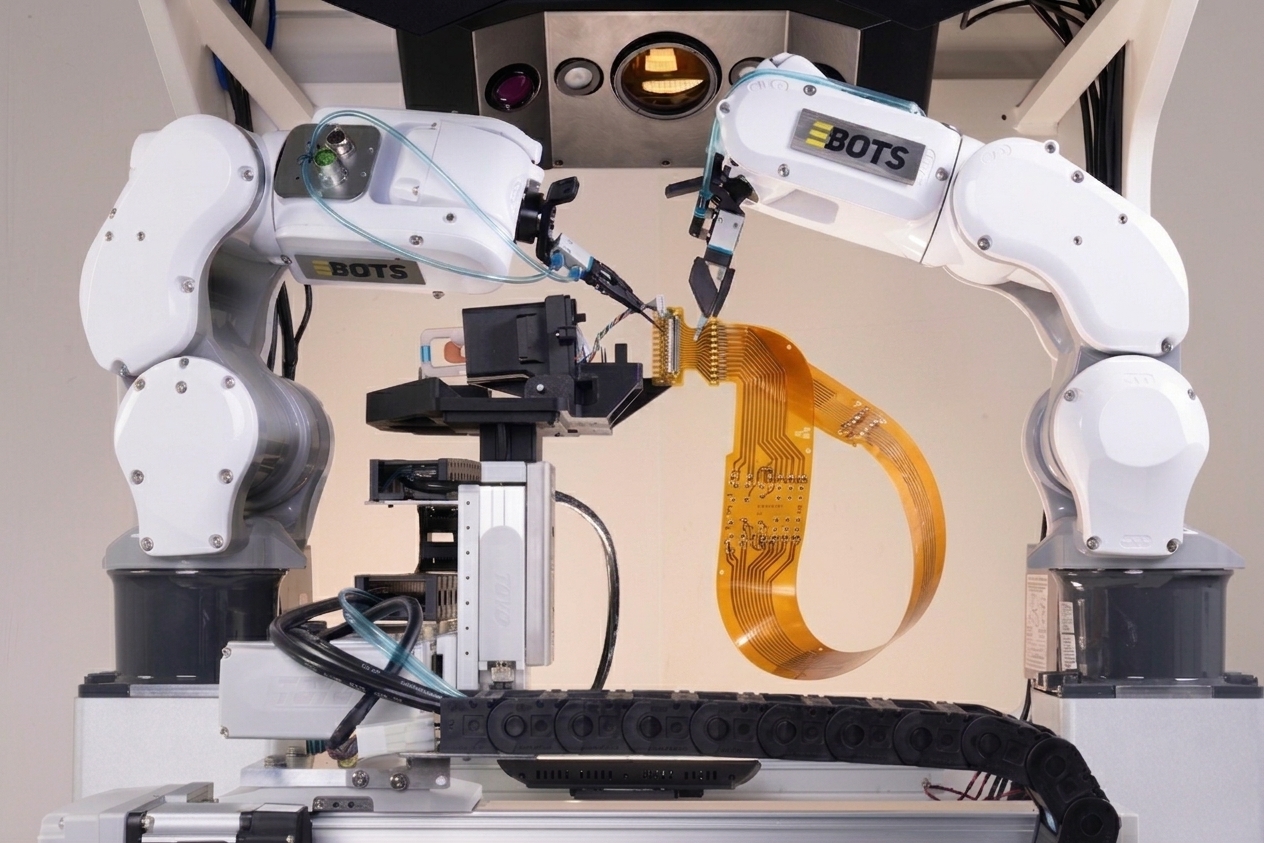
This simplicity is being pushed even further by pioneers in the field. For example, some advanced systems from Ebots use an AI and 3D vision platform to learn new assembly tasks in as little as 15 minutes, making changeovers nearly instant.
Boosting Efficiency and Quality
Cobots deliver measurable improvements in productivity and product quality.
Increased Throughput: Cobots work consistently without breaks or fatigue. One manufacturer reported a 400% productivity boost after deploying a cobot for 24 hour machine tending.
Improved Consistency: By performing tasks with the same precision every time, cobots drastically reduce human error and variability. In one electronics assembly line, introducing cobots improved first pass yield from around 85% to over 99%.
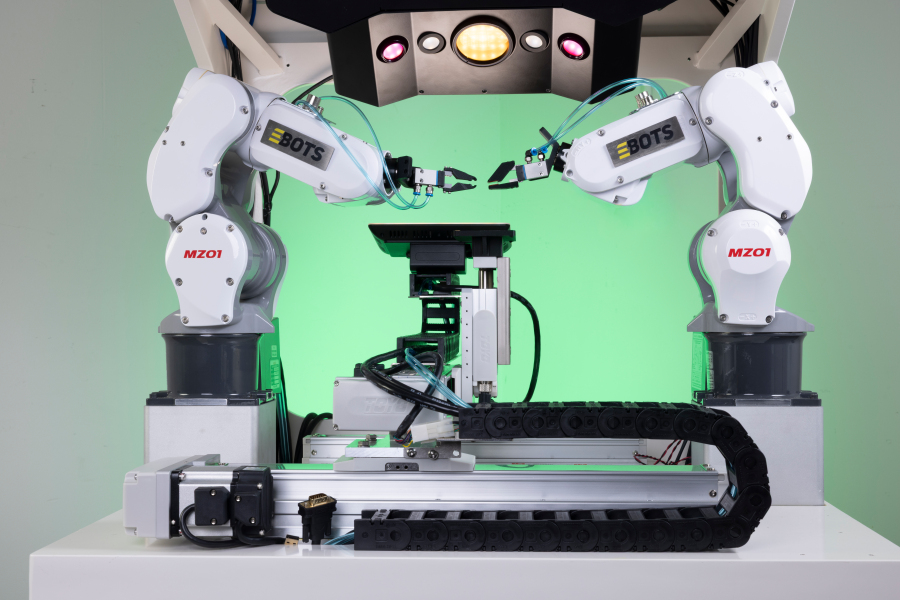
Reduced Waste: Higher consistency means fewer defects, less scrap material, and less rework, which directly impacts the bottom line. This leap in quality is what advanced systems are built for. For instance, manufacturers using Ebots’ dual-arm cobots have seen similar jumps in first pass yield, virtually eliminating costly errors.
Calculating the ROI of Cobotics
Thanks to their lower initial cost and ease of integration, cobots offer a much faster return on investment than traditional automation. Payback periods are often measured in months, not years. Universal Robots has estimated a typical payback period of just 195 days.
When you factor in savings from reduced labor turnover, fewer workplace injuries, and higher output, the business case becomes clear. Companies struggling with labor shortages find that cobots can fill critical gaps, ensuring production remains stable and scalable.
Cobotics in Action: Real World Applications
Cobots are no longer a futuristic concept; they are already at work across numerous industries, solving real world challenges.
Cobots in Manufacturing
Manufacturing is the largest market for cobotics. Cobots are ideal for automating tasks that are repetitive, ergonomically challenging, or require high precision.
Assembly: Inserting screws, applying adhesives, and snapping components together.
Machine Tending: Loading and unloading CNC machines, injection molders, and presses.
Quality Inspection: Using cameras and sensors to check for defects with perfect consistency.
Packaging and Palletizing: Packing finished goods into boxes and stacking them onto pallets.
Cobots in Logistics and Warehousing
The logistics sector is rapidly adopting cobotics to handle the surge in e commerce.
Order Fulfillment: Picking items from shelves and placing them into order bins.
Sorting: Directing packages to the correct outbound lanes in shipping centers.
Palletizing and Depalletizing: Building and breaking down pallets of goods in warehouses.
A Deep Dive into Automotive Cobotics
The automotive industry has been a pioneer in using cobotics for final assembly. At a Ford plant, for example, cobots assist workers in installing heavy shock absorbers. The cobot lifts and holds the part, relieving the worker from physical strain, while the human performs the final alignment and fastening. This kind of collaborative work improves ergonomics, speed, and quality simultaneously. From installing windshields to torquing bolts in tight spaces, cobots are becoming indispensable partners on the modern assembly line.
Getting Started: Preparing Your Workspace for a Cobot
Deploying a cobot is simpler than traditional automation, but some workspace preparation is still needed.
Assess the Workflow: Clearly define which tasks the cobot will do and which the human will do.
Plan the Layout: Ensure there is enough clearance for the cobot’s movements. Since no large cages are needed, the footprint is small.
Perform a Risk Assessment: Evaluate the complete application (robot, tool, and task) to identify and mitigate any potential hazards. risk assessment templates and deployment guides can help you get started.
Integrate with Equipment: Connect the cobot to any machines or sensors it needs to communicate with.
Train Your Team: Familiarize operators with how to safely interact with their new robotic coworker.
The Future of Cobotics
The future of cobotics is bright, driven by advances in AI, sensors, and machine learning. The global collaborative robot market is projected to grow from around $1.5 billion in 2023 to over $23 billion by 2033.
Here’s what to expect:
Smarter Robots: AI will enable cobots to be programmed with natural language and learn from observing humans.
Greater Dexterity: Cobots will be able to handle a wider range of objects and perform more delicate tasks.
Increased Mobility: Mobile cobots, or robotic arms on autonomous bases, will become more common, able to move around a facility to assist where needed.
Expansion into New Industries: We will see cobots appearing in healthcare, agriculture, construction, and even commercial kitchens.
Innovators are already building this future. Companies like Ebots are pioneering next-generation autonomous robots, AI-driven, dual-arm cobots that deliver superhuman precision and can be reconfigured for new tasks in minutes. This is paving the way for highly adaptable “lights out” manufacturing where humans and robots work in perfect sync. For a broader view of where precision manufacturing is headed, see the evolution of precision manufacturing.
Frequently Asked Questions about Cobotics
1. What is the main difference between a robot and a cobot?
The primary difference is collaboration. A cobot (collaborative robot) is designed to work safely alongside humans in a shared workspace without safety cages. A traditional industrial robot is typically isolated from humans due to its high speed and power.
2. Are cobots completely safe to work with?
Cobots are designed with numerous safety features like force limiting and speed monitoring to be inherently safe. However, every application requires a thorough risk assessment to ensure the entire system, including the tool and the task, is safe for human interaction.
3. How long does it take to program a cobot?
Thanks to intuitive interfaces and hand guiding, basic cobot programming can often be learned in a few hours. A simple pick and place task can be set up in under 30 minutes, compared to the days or weeks it might take to program a traditional robot.
4. What industries use cobotics the most?
Manufacturing, particularly in the automotive and electronics sectors, is the largest user of cobotics. However, logistics, warehousing, pharmaceuticals, and food and beverage are all rapidly adopting the technology.
5. Will cobots replace human workers?
The goal of cobotics is not to replace humans but to augment their abilities. Cobots take over repetitive, strenuous, and dangerous tasks, allowing human workers to focus on more complex, value added activities like quality control, problem solving, and process improvement.
6. What is the average cost of a collaborative robot?
While prices vary by brand, payload, and features, many cobot models are priced between $20,000 and $50,000. This is significantly less than traditional industrial robots, which can easily exceed $100,000 once integration costs are included.
Ready to see how cobotics can transform your operations? Schedule a consultation with our team to map out ROI and next steps.