Content
Robotics in Manufacturing: Types, Benefits & Future
Once a concept reserved for science fiction, robotics in manufacturing has become the powerful engine driving modern industry. From massive automotive plants to sterile cleanrooms for electronics, robots are no longer a futuristic novelty but an essential tool for companies aiming for higher productivity, flawless quality, and a competitive edge. With an estimated 4.28 million industrial robots already working in factories worldwide, it’s clear that automation is reshaping how we make things.
This guide breaks down everything you need to know about the role of robotics in manufacturing. We’ll explore the history, define the different types of robots you’ll find on a factory floor, and look at the benefits, challenges, and exciting future of this transformative technology.
A Quick Look Back: The History of Robotics in Manufacturing
The story of industrial automation began over 60 years ago. The very first industrial robot, named Unimate, was installed at a General Motors plant in 1961. Its job was simple but dangerous, handling hot pieces of die cast metal. This single act proved that machines could reliably perform repetitive and hazardous tasks, sparking a revolution.
Growth was exponential. The number of industrial robots in operation jumped from around 200 in 1970 to nearly 1.6 million by 2015, and it topped 3 million by 2020. Early on, the automotive industry was the biggest adopter, using robots for welding and painting. As recently as 2017, the auto sector accounted for about two thirds of all robot orders.
However, the last decade has seen incredible diversification. Today, industries like electronics, food and beverage, and pharmaceuticals are rapidly adopting robotics. In a major shift, 2020 was the first year that a majority of new robot orders in North America came from outside the auto industry, with sectors like life sciences increasing purchases by 69%. This shows how integral robotics in manufacturing has become across the board.
What Exactly Is an Industrial Robot?
An industrial robot is officially defined as an automatically controlled, reprogrammable, multipurpose manipulator programmable in three or more axes.
In simpler terms, it’s a machine designed to automate physical tasks in a manufacturing process. A typical industrial robot consists of a mechanical arm, a controller (the brains), and an end effector (the tool, like a gripper or a welder). They are built for endurance and precision far beyond human capabilities, executing the same motion thousands of times with negligible variation. With over 500,000 new robots being installed annually in recent years, these machines are the backbone of modern high volume production.
The Main Players: Types of Robots in Manufacturing
Industrial robots aren’t one size fits all. They come in various shapes and designs, each optimized for different jobs. Here are the most common types you’ll encounter.
Articulated Robots
Articulated robots are the most common type of industrial robot, easily recognized by their human arm like structure with rotating joints. They typically have four to six axes, giving them incredible flexibility and a wide range of motion. This versatility makes them perfect for complex tasks like cobot welding, painting, assembly, and machine tending. Their payload can range from just a few kilograms to massive models capable of lifting over 2,300 kg.
SCARA Robots
SCARA stands for Selective Compliance Assembly Robot Arm. These robots are speed demons for pick and place operations. With two parallel joints, they are exceptionally fast and precise in a horizontal plane. This design makes them ideal for rapid assembly tasks, especially in the electronics industry where they place tiny components onto circuit boards with incredible accuracy.
Delta Robots
Also known as parallel or spider robots, Delta robots are built for lightning fast picking and packing of lightweight items. They feature three or four slender arms connected to a common base, allowing them to achieve very high speeds. It’s not uncommon for a Delta robot to perform over 100 picks per minute, making them a staple in the food and pharmaceutical industries for sorting and packaging.
Cartesian Robots
Cartesian robots, also called gantry or linear robots, operate on three linear axes: X, Y, and Z. This straightforward, rigid design provides a rectangular work envelope, making them ideal for tasks like CNC machining, 3D printing, and palletizing heavy loads. Their simplicity also makes them easy to program and highly accurate for straight line movements.
Cylindrical Robots
Cylindrical robots have a rotary joint at the base and linear joints for arm extension and height, creating a cylindrical work envelope. While less common today, they were popular in early robotics for machine loading and spot welding, especially when workstations were arranged in a circle around the robot.
The New Wave of Automation
Beyond the traditional designs, a new generation of robots is making automation more accessible, intelligent, and flexible.
Collaborative Robots (Cobots): The Human Friendly Coworkers
A collaborative robot (cobot) is designed to work safely alongside humans without the need for safety cages. Cobots are equipped with sensors that allow them to stop if they make contact with a person, making them ideal for shared workspaces. They are often easier to program, with many models supporting hand guiding where an operator simply moves the arm through a path to teach it. Cobots are one of the fastest growing segments of robotics in manufacturing; our Industrial Cobots 2025 guide to costs, safety, and use cases explains where they fit best, accounting for about 10.5% of all industrial robots installed in 2023.
Autonomous Mobile Robots (AMRs): The Factory Floor Navigators
Autonomous Mobile Robots (AMRs) are self driving vehicles that transport materials within a factory or warehouse. Unlike older Automated Guided Vehicles (AGVs) that followed fixed paths, AMRs use sensors and internal maps to navigate dynamically, even avoiding unexpected obstacles. The adoption of these logistics robots is booming, with sales growing 35% in 2023 alone. E commerce giant Amazon now uses over one million mobile robots in its fulfillment centers to move goods, showcasing their massive potential.
Specialized Robots: Built for a Purpose
While many robots are generalists, some are purpose built for a specific job, like welding, painting, or operating in a cleanroom. This specialization often delivers superior performance.
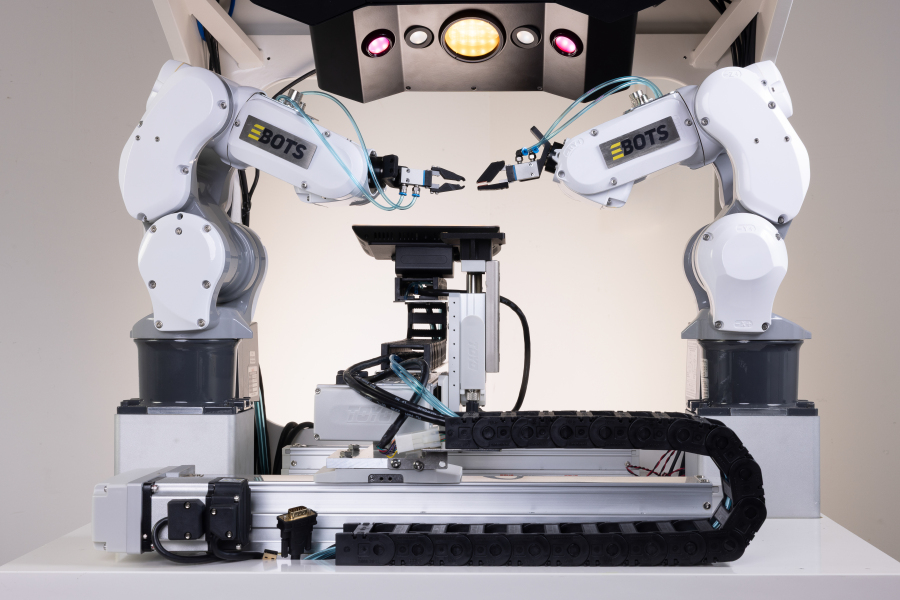
A prime example of modern specialized robotics in manufacturing is in complex assembly. Many precision tasks, like routing flexible cables or connecting tiny components, have historically been too difficult for rigid, single arm robots. This is where advanced, dual arm robotic systems shine. By mimicking the dexterity of two human hands and using AI powered 3D vision, these robots can execute intricate, multi step processes with incredible accuracy.
For companies struggling with low yields and high labor turnover on precision assembly lines, this technology is a game changer. Solutions from Ebots are designed to solve these exact problems, delivering consistent quality and higher throughput where traditional automation falls short.
The “Why”: Key Benefits of Robotics in Manufacturing
Integrating robotics offers transformative advantages that boost a company’s bottom line and overall performance.
Increased Productivity: Robots can work 24/7 without breaks or fatigue, dramatically increasing output. They keep production lines running even during labor shortages, a challenge many manufacturers face. For example, Batesville Tool & Die invested in robotics to maintain high output despite a tight labor market, which helped them grow their business.
Consistent Quality and Precision: Automation eliminates human variability. Robots perform tasks with exceptional repeatability, leading to fewer defects, less waste, and higher first pass yields. Advanced systems can achieve near perfect consistency. For instance, Ebots’ dual arm robots have demonstrated 99.95%+ first pass yields on delicate assembly tasks, virtually eliminating rework.
Solving Labor Shortages: With projections showing 2 million manufacturing jobs could go unfilled by 2025 due to skills gaps, robots are a critical solution. They can take over undesirable or hard to fill roles, stabilizing production capacity.
Improved Safety: Robots excel at tasks that are dull, dirty, dangerous, or difficult, removing human workers from hazardous environments. This reduces workplace injuries related to heavy lifting, exposure to fumes, or repetitive strain.
Greater Flexibility: Modern robots are not rigid. They can be reprogrammed for new tasks, which is vital as product cycles shorten. Advanced AI driven robots can be reconfigured in minutes, not weeks. The dual arm systems from Ebots can learn a new assembly process in under 15 minutes, offering unprecedented agility for high mix production environments.
Cost Savings: All of the above benefits lead to significant cost reductions. Lower scrap rates, higher throughput, reduced labor costs, and fewer workplace accidents all contribute to a strong return on investment.
The Hurdles: Challenges of Robotics Integration
Despite the clear advantages, adopting robotics in manufacturing comes with challenges.
High Initial Cost: The upfront investment for a robotic cell, including the robot, tooling, and integration, can be significant, especially for small and medium sized businesses. While robot prices have been falling, the total project cost can still be a barrier.
Technical Expertise: Integrating and maintaining robots requires specialized skills in programming and engineering, which may not be available in house. This skills gap is a major hurdle for many companies.
Lack of Flexibility: Traditional robots can be rigid. Reprogramming them for new products can cause significant downtime. This is a problem in high mix, low volume manufacturing, where agility is key. However, new technologies are directly addressing this pain point.
Task Complexity: Not all tasks are easy to automate. Handling soft or deformable parts (like cables and gaskets) or performing delicate assembly that requires a human like sense of touch has been historically difficult for robots.
Fortunately, modern robotics companies are tackling these challenges head on; see how manufacturers are transforming legacy operations to overcome staffing volatility and process variability. For instance, the Ebots self-learning platform is designed specifically to automate complex, high precision tasks that were previously impossible, combining AI, vision, and dual arm coordination to deliver human like dexterity.
Robotics in Manufacturing: Real World Success Stories
The proof of robotics’ impact is in the results.
One powerful example comes from the world of high tech electronics assembly. On an Apple iPad production line, certain intricate assembly tasks that were performed manually had first pass yields around 85%. After deploying advanced dual arm AI robots from Ebots, accuracy skyrocketed to over 99%. This drastic reduction in defects not only saved millions in rework costs but also increased throughput, ensuring product launches stayed on schedule.
Another case study is Batesville Tool & Die, a metal stamping company that faced a severe labor shortage. By strategically implementing robots to handle tedious, heavy work, the company was able to maintain high output and even increase wages for its human employees, who were upskilled to manage the new automated systems. This shows that robotics in manufacturing can be a win win, boosting productivity while creating better jobs.
What’s Next? Innovations and the Future of Robotics in Manufacturing
The field of robotics in manufacturing is evolving faster than ever, driven by breakthroughs in artificial intelligence, sensing, and computing.
Artificial Intelligence and Machine Learning: AI is making robots smarter. They can now learn from experience, adapt to variability in parts, and optimize their own movements without human intervention. Generative AI is even being used to automatically create robot programs, drastically simplifying setup.
Advanced Vision and Sensing: With high resolution 3D cameras and tactile sensors, robots can see and “feel” with near human acuity. This enables complex tasks like random bin picking and delicate assembly that require precise hand eye coordination.
The Rise of Humanoid Robots: While still in early stages, companies like Tesla are developing humanoid robots designed to work in human centric environments. Nvidia’s CEO, Jensen Huang, predicts that humanoid robots could become a common sight in factories within the next few years, tackling tasks that require a human like form factor.
Tighter Human Robot Collaboration (often called cobotics): The future factory will not be devoid of people. Instead, humans and robots will work in closer collaboration than ever before. Humans will handle strategy, creativity, and complex problem solving, while their robotic counterparts perform the physical labor with superhuman precision and endurance.
The end goal is the “lights out” factory, a fully autonomous facility that can run 24/7 with minimal human oversight. This vision is rapidly becoming a reality, powered by the convergence of AI, IoT, and advanced robotics in manufacturing.
For manufacturers looking to stay ahead of the curve, embracing these innovations is not just an option, it is a necessity. Investing in intelligent, adaptable automation platforms is the key to building the resilient and hyper efficient factory of the future.
Frequently Asked Questions about Robotics in Manufacturing
What is the main purpose of robotics in manufacturing?
The main purpose is to automate physical tasks to improve productivity, quality, and safety. Robots handle repetitive, strenuous, or dangerous jobs, allowing manufacturers to produce goods faster, more consistently, and more cost effectively.
Which industry uses robotics the most?
Historically, the automotive industry has been the largest user of industrial robots for tasks like welding and painting. However, other sectors, especially electronics, are now adopting robots at an extremely rapid pace and are closing the gap.
Are robots going to replace all manufacturing jobs?
It’s unlikely. While robots will replace certain manual tasks, they also create new, higher skilled jobs in areas like robot programming, maintenance, and data analysis. The future points toward a collaborative model where humans and robots work together, with people shifting to more creative and strategic roles.
How much does an industrial robot cost?
The cost varies widely. A small collaborative robot might cost around $25,000, while a large, heavy payload articulated robot can exceed $100,000. However, this is just the hardware cost; the total cost of a fully integrated robotic cell, including tooling, safety systems, and programming, is often much higher.
What is the difference between a robot and a cobot?
A traditional industrial robot operates at high speeds and is typically kept inside a safety cage to prevent human contact. A cobot (collaborative robot) is designed with built in safety features that allow it to work safely alongside humans in a shared workspace without barriers.
How is AI changing robotics in manufacturing?
AI is giving robots “brains.” It enables them to see and understand their environment, learn from data to improve performance, and adapt to unpredictable situations. This allows robots to handle more complex, less structured tasks that were previously impossible to automate.
If you’re ready to see how the latest advancements in AI and robotics can transform your assembly lines, talk to an automation specialist and start building your factory of the future today.