Content
Types of industrial robots: 7 core models and uses
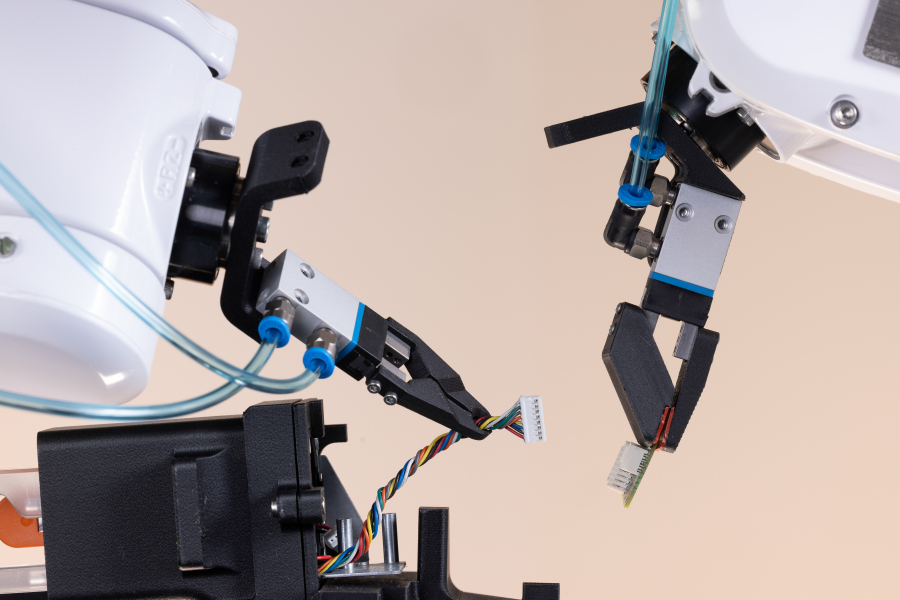
Industrial robots are transforming manufacturing at an incredible pace. In 2024 alone, a record 542,000 new industrial robots were installed across the globe, more than double the number from just a decade ago. But when we talk about factory automation, it’s not a one size fits all solution. The truth is, there are several different types of industrial robots, each designed with a unique structure and purpose.
Understanding these core designs is the first step to finding the right automation for your needs. This guide breaks down the seven primary types of industrial robots you’ll find in modern industry: articulated, SCARA, delta, Cartesian, and collaborative robots, as well as the foundational cylindrical and polar designs. We’ll explore how they work, their common applications, and what makes each one unique.
Articulated Robots: The All Around Powerhouse
Think of a human arm, with a shoulder, elbow, and wrist. That’s the basic concept behind an articulated robot. It’s a robotic arm with multiple rotary joints, typically giving it 6 degrees of freedom for incredible flexibility. This design allows it to pivot, twist, and position a tool at almost any angle within its work area.
Because of this versatility, articulated robots are the most common type of industrial robot used in manufacturing today. Their ability to maneuver around obstacles makes them perfect for complex jobs.
Common Applications:
Welding and painting
Assembly and fabrication
Material handling and packaging
Machine loading and unloading
Articulated robots can handle everything from assembling tiny electronics to lifting car bodies weighing over 500 kg. Their blend of reach, flexibility, and strength makes them an indispensable part of modern production.
Advanced systems are taking this design even further. For instance, Ebots’ dual‑arm robotic cells use AI and 3D vision to coordinate two arms on complex tasks with human‑like dexterity. By integrating state‑of‑the‑art articulated robots, manufacturers can dramatically boost quality and throughput.
SCARA Robots: The Speed and Precision Specialist
SCARA stands for Selective Compliance Assembly Robot Arm, a name that perfectly describes its function. This robot is selectively compliant, meaning it’s flexible in the horizontal (X and Y) plane but extremely rigid in the vertical (Z) axis. It typically has four axes, allowing it to move quickly across a flat plane and perform precise vertical insertions.
This unique design makes SCARA one of the most effective types of industrial robots for rapid assembly and pick and place tasks.
Common Applications:
Electronics component insertion
Small parts assembly
Packaging and sorting
Dispensing and screw driving
Invented in Japan in 1978 to automate electronics assembly, SCARAs are the unsung heroes of the tech industry, often placing components with a repeatability of ±0.01 mm. Their speed is second only to delta robots, making them a cost effective choice for high throughput operations. The global market for SCARA robots was valued at around $11 billion in 2024, highlighting their importance in modern factories. For how micron‑level accuracy translates to yield on the line, see Mastering Microns: How Ebots Redefines Precision Manufacturing.
Delta Robots: The Unbeatable High Speed Picker
If you need pure, unadulterated speed for small parts, the delta robot (a type of parallel robot) is in a class of its own. Instantly recognizable by its spider like design, a delta robot uses three or four lightweight arms connected to a single platform from above. Since the heavy motors are fixed in the base instead of the moving arms, the robot has very low inertia.
This allows for incredible acceleration, with some models achieving over 15 times the force of gravity and completing more than 200 picks per minute. First invented in 1985 to handle delicate chocolates, the delta robot has become an industrial standard.
Common Applications:
High speed pick and place
Sorting and grouping
Packaging for food, pharmaceutical, and electronics industries
Light assembly of small components
When you see products flying off a conveyor belt and into packages at a seemingly impossible speed, you are likely watching a delta robot at work. For high volume pick and place of light items, no other robot type comes close.
Cartesian Robots: The Simple and Scalable Workhorse
A Cartesian robot, also known as a gantry or rectilinear robot, operates on a simple principle: three linear axes at right angles to each other (X, Y, and Z). It moves in straight lines within a cube shaped work area, making it incredibly straightforward to program and highly precise.
Many familiar machines, including 3D printers and CNC machines, are built on a Cartesian motion system. Their rigid structure provides excellent repeatability, and their design can be scaled from a small desktop unit to a massive gentry system spanning a factory floor.
Common Applications:
Pick and place over large areas
Loading and unloading CNC machines
Component insertion and PCB routing
Automated inspection and measurement
While they lack the flexibility to reach around things, Cartesian robots are a cost effective and reliable solution for tasks that involve simple, point to point movements.
Collaborative Robots (Cobots): The Human Friendly Partner
One of the fastest growing segments in automation is collaborative robots, or cobots. New to the concept? Start with our complete guide to what a cobot is, benefits, and applications. These are types of industrial robots specifically designed to work safely alongside human employees without the need for large safety cages. Cobots are equipped with advanced sensors and force‑limiting joints that cause them to stop or reverse gently upon contact with a person. For safety standards, ROI models, applications, and FAQs, see Collaborative Robots: Safety, ROI, Applications, and FAQs.
Introduced by Universal Robots in 2008, cobots have lowered the barrier to automation, especially for small and medium sized businesses. They allow factories to blend the best of human and machine work. A person might handle complex quality checks while a cobot performs the repetitive, physically demanding parts of the job.
Common Applications:
Light assembly and screw driving
Machine tending and quality inspection
Packaging and palletizing
Finishing tasks like polishing or deburring
Cobots are a powerful tool for addressing labor shortages and improving consistency on existing production lines. For example, Ebots’ advanced dual arm cobots can safely work next to technicians, taking over repetitive fine assembly with superhuman consistency. By letting robots handle the tedious tasks while people focus on skilled oversight, manufacturers can significantly improve both output and quality. If welding is a priority, explore cobot welding benefits, costs, ROI, and how to start.
Cylindrical and Polar Robots: A Look at the Originals
While less common today, it’s helpful to understand the older types of industrial robots that paved the way for modern automation.
Cylindrical Robots
A cylindrical robot has a rotating base and an arm that moves up and down a vertical column and extends in and out. This creates a cylinder shaped work envelope. They were once used for simple machine loading and assembly but have been largely replaced by faster and more precise SCARA robots.
Polar Robots
Also known as spherical robots, these have a rotating base, a pivoting shoulder, and an arm that can extend and retract. This gives them a partial sphere shaped work area. The very first industrial robot, the Unimate, had a polar design. Today, their role has been taken over by more flexible articulated robots, which offer better reach and accuracy.
Choosing the Right Automation Partner
Each of the types of industrial robots has unique strengths tailored to different jobs. A modern factory might use Cartesian robots for drilling, SCARAs for component placement, and articulated arms for final assembly. The key is matching the robot to the task.
If you’re looking to modernize your operations, it helps to consult with experts. Ebots has deep expertise in deploying advanced robotics, from agile dual‑arm cobots to next‑generation autonomous robots and fully autonomous production cells. Their team provides a consultative approach, including custom ROI analyses to identify how robotics can boost your bottom line.
Ready to transform your manufacturing? Contact Ebots for a personalized assessment and take the first step toward scalable, high‑precision automation.
Frequently Asked Questions About the Types of Industrial Robots
What are the 5 main types of industrial robots?
The five most common types of industrial robots found in factories today are Articulated, SCARA, Delta, Cartesian, and Collaborative (Cobots). Older types like Cylindrical and Polar are now much less common in new installations.
What is the most common type of industrial robot?
Articulated robots are the most common type. Their human like arm structure, with six or more axes of motion, makes them incredibly versatile for a wide range of tasks like welding, painting, and complex assembly.
Which robot is best for high speed pick and place?
For picking and placing small, lightweight items at the highest possible speed, the Delta robot is the top choice. For slightly heavier payloads or tasks requiring more precision in a flat plane, the SCARA robot is also an excellent and very fast option.
What is the difference between an industrial robot and a cobot?
The main difference is safety and operation. Traditional industrial robots are powerful and fast, requiring safety fences to protect human workers. A collaborative robot, or cobot, is designed with sensors and force limits to operate safely alongside people in a shared workspace without cages.
How do I choose the right type of industrial robot for my business?
Choosing the right robot depends on several factors, including the specific task (e.g., assembly, welding, packaging), the required payload (weight of the part and tool), speed (cycle time), reach (work area size), and precision. Consulting with an automation expert can help you analyze these needs to select the best of all the types of industrial robots for your application.