Content
Manufacturing Robots: Types, Benefits, and How They Work
Manufacturing robots are no longer a futuristic concept; they are the powerhouse behind modern production. From building cars to assembling smartphones, these automated systems are reshaping how we make things. They offer a potent combination of speed, precision, and endurance that human labor simply cannot match. With an estimated 4.28 million industrial robots already working in factories worldwide, understanding them is crucial for any manufacturing leader.
This guide breaks down everything you need to know about manufacturing robots, from the basic types and how they work to the tangible business benefits they deliver.
What Are Manufacturing Robots?
An industrial or manufacturing robot is an automated, programmable machine designed to move and manipulate objects in a production environment. Defined by the ISO 8373 standard, these robots typically operate on three or more axes, giving them the flexibility to perform complex tasks like welding, painting, assembly, and packaging with incredible speed and precision. They are built to work tirelessly, repeating tasks with a level of accuracy that far surpasses human capabilities.
Key Robot Parameters to Know
When choosing a manufacturing robot, you’ll encounter a few key specifications that define its performance:
Degrees of Freedom (DOF) or Axes: This is the number of directions a robot can move. A six axis robot can reach any point in its workspace with any orientation, making it extremely versatile.
Payload Capacity: The maximum weight the robot can carry. This can range from a few kilograms for small assembly robots to over 1,000 kilograms for heavy duty lifting.
Working Envelope: The three dimensional space that the robot’s end effector can reach.
Speed: How fast the robot’s joints or tool can move, often measured in meters per second.
Repeatability: A measure of how precisely a robot can return to the same programmed point. Many manufacturing robots boast repeatability within a fraction of a millimeter (e.g., ±0.02 mm), which is key for quality and true micron-level precision.
The Different Types of Manufacturing Robots
Manufacturing robots come in various shapes and sizes, each designed for different applications. They are often classified by their mechanical structure or architecture.
Serial vs. Parallel Architecture
First, it helps to understand the two main robot architectures:
Serial Manipulators: This is the most common design, featuring a single chain of links connected by joints, like a human arm. Most industrial robots, including articulated and SCARA types, are serial manipulators, prized for their large work envelopes and flexibility.
Parallel Robot Architecture: These robots connect their base to a single moving platform using multiple arms, or legs, that work together. This design offers incredible stiffness, speed, and precision, though often in a smaller workspace.
Common Robot Types
Here are the main types of manufacturing robots you’ll find on the factory floor:
Articulated Robot
Resembling a human arm, an articulated robot uses rotary joints to provide a wide range of motion, typically with six axes. They are the most common type of industrial robot, making up a huge portion of the market due to their versatility. You’ll see them doing everything from welding car bodies to assembling delicate electronics.
SCARA Robot
SCARA stands for Selective Compliance Assembly Robot Arm. These robots have two parallel joints that allow them to move quickly and precisely in a horizontal plane while remaining rigid vertically. This unique design makes them perfect for high speed assembly and pick and place tasks, like placing components on a circuit board.
Cartesian Robot
Also known as gantry or linear robots, Cartesian robots move in straight lines along X, Y, and Z axes. Their rigid, overhead structure allows them to handle heavy payloads with high precision over large areas. They are often used for tasks like machine tending, palletizing, and large scale assembly.
Delta Robot
A type of parallel robot, the Delta robot is known for its spider like appearance and incredible speed. Its lightweight arms are all connected to a single platform, allowing for extremely rapid acceleration. Delta robots dominate high speed pick and place applications in the food, pharmaceutical, and electronics industries.
Cylindrical and Spherical Robots
These are earlier robot designs that have become less common but are still part of robotics history.
Cylindrical Robot: Moves within a cylindrical workspace using a rotary base and linear arm movements (up and down, in and out). They have largely been replaced by faster and more flexible SCARA robots.
Spherical Robot: Also called a polar robot, this design uses a combination of rotary and linear joints to operate within a spherical work area. The pioneering Unimate robot of the 1960s had this configuration.
Modern Categories of Manufacturing Robots
Beyond structural types, two modern categories are transforming automation:
Collaborative Robot (Cobot)
A collaborative robot (cobot) is designed to work safely alongside humans without traditional safety cages. Cobots are equipped with sensors and force limiting technology that allows them to stop if they make contact with a person. Their ease of use and flexibility have made them popular in small and mid sized businesses for tasks like light assembly and machine tending.
Mobile Industrial Robot
These robots, including Autonomous Mobile Robots (AMRs) and next-generation autonomous robots, are not fixed to one spot. They navigate factory floors and warehouses to transport materials, parts, and finished goods. In 2023, sales of mobile robots for logistics grew by an impressive 35%, showing a huge demand for automating internal transportation.
How Manufacturing Robots Get the Job Done
A robot arm is just one piece of the puzzle. To perform a task, it needs a tool, a program, and a control system.
End of Arm Tool (EOAT)
The End of Arm Tool, or end effector, is the robot’s “hand.” It’s the device that interacts directly with parts. Common EOATs include:
Grippers: For picking up objects, using jaws, suction cups, or magnets.
Welding Torches: For automated arc or spot welding.
Dispensing Tools: For applying paint, glue, or sealant.
Sensors: Such as cameras or force torque sensors for inspection or delicate assembly.
Robot Programming and Interface
Instructing a robot can be done in several ways:
Teach Pendant: The traditional method, where an operator uses a handheld controller to jog the robot to specific points and record them. Over 90% of robots have historically been programmed this way.
Offline Programming: Using software to create and simulate robot programs on a computer, which minimizes production downtime.
Lead Through Teaching: Physically guiding the robot arm through the desired motions, which the robot then records and repeats.
Robot Motion Control
A robot’s controller is its brain. It translates a program’s commands into precise, coordinated movements for each joint motor. The controller handles complex calculations for smooth motion, including:
Interpolation: Ensuring the tool moves in a straight line or a perfect arc between points.
Speed and Acceleration Profiles: Managing movement to be both fast and smooth, preventing jerky motions and mechanical wear.
Dynamic Compensation: Using the robot’s physical model to compensate for gravity or payload, ensuring high accuracy.
The Robot Programming Workflow
Deploying a manufacturing robot follows a clear process:
Define the Task: Plan the process and the layout of the robotic cell.
Setup and Calibrate: Install the EOAT and define the tool center point (TCP).
Program the Path: Teach or code the robot’s movements and logic.
Simulate and Test: Run the program in a simulation or at slow speed to check for collisions and errors.
Deploy and Tune: Run the robot in production, making small adjustments to optimize cycle time and performance.
A Note on Robot Singularity
During programming, it’s important to avoid “singularities.” A singularity is a joint configuration where the robot loses its ability to move in a certain direction, which can cause erratic or unpredictable motion. A common example is a “wrist flip,” where the robot’s wrist has to rotate suddenly to avoid an alignment issue. Good programming software helps identify and avoid these zones.
The Powerful Business Case for Manufacturing Robots
Companies invest in manufacturing robots for a simple reason: they deliver a strong return on investment. The benefits span productivity, quality, safety, and cost savings.
Boosting Efficiency and Productivity
Robots work 24/7 without breaks or fatigue, dramatically increasing throughput. They move faster and more consistently than human workers, leading to shorter cycle times and predictable output. One case study showed a 150% productivity increase after a robot automated a task previously done by three people. By taking over repetitive tasks, manufacturing robots free up human employees to focus on higher value work, boosting the entire team’s output.
Driving Unmatched Quality Improvement
Precision and consistency are where manufacturing robots truly shine. By eliminating human error and process variability, robots significantly improve product quality. Their high repeatability ensures every weld, screw, or placement is performed exactly the same way every time. This leads to higher first pass yields and less scrap and rework. Some advanced robotic systems can even improve assembly accuracy from 85% to over 99%, nearly eliminating defects.
Delivering Substantial Cost Savings
The financial benefits of manufacturing robots are compelling. Key areas of cost savings include:
Reduced Labor Costs: A single robot can often perform the work of multiple operators across several shifts, with most robots delivering a return on investment in under two years.
Lower Scrap and Rework: Better quality means less wasted material and labor.
Increased Throughput: Producing more units with the same facility overhead lowers the cost per part.
Some advanced, AI driven robotic cells can eliminate over $75,000 in annual costs per workstation and pay for themselves in months, not years. For manufacturers struggling with high labor turnover and inconsistent output, this is a game changer. Discover how next‑generation manufacturing robots can transform your operational costs in our Industrial Cobots: 2025 Guide to Costs, Safety, and Use Cases.
Creating a Safer and Healthier Workplace
Robots excel at the “dull, dirty, and dangerous” jobs that pose risks to human workers. By automating tasks like heavy lifting, handling hazardous materials, or performing repetitive motions, robots reduce workplace injuries. One study found that a standard deviation increase in robot use was associated with a 1.2 case drop in injury rates per 100 workers. This creates a safer environment, improves employee morale, and lowers costs associated with accidents and repetitive strain injuries.
Overcoming the Challenges of Automation
While powerful, traditional manufacturing robots have faced some limitations.
The Maintenance Cost Factor
Like any machine, robots require maintenance. Preventive servicing, repairs, and spare parts are all part of the total cost of ownership. On average, maintenance can account for about 20% of a robot’s total cost over its lifespan. However, this is typically a predictable expense and is often far less than the ongoing costs of manual labor. With proper preventive care, a robot can run reliably for tens of thousands of hours.
The Flexibility Challenge
Historically, a key limitation of manufacturing robots was their lack of flexibility. Reprogramming a robot for a new product could take hours or even weeks, making them ill‑suited for high‑mix, low‑volume production (see how manufacturers are transforming legacy operations). They also struggled with tasks requiring human like dexterity, such as handling flexible cables or assembling complex components. This rigidity created a barrier for many manufacturers who needed to adapt quickly to changing demands.
The Future: AI and Innovation in Manufacturing Robotics
Fortunately, innovation is rapidly overcoming these traditional limitations. The integration of Artificial Intelligence (AI) is making manufacturing robots smarter, more adaptable, and easier to use.
AI is transforming robotics in several key ways:
Advanced Vision and Perception: AI allows robots to “see” and understand their environment. They can identify randomly oriented parts in a bin, read text, or inspect for subtle defects.
Learning and Adaptation: Instead of being programmed for every possibility, AI powered robots can learn from experience. They can optimize their own motions or adapt to variations in parts without human intervention.
Faster Programming: A major trend is making robots easier to program for non experts. AI driven systems can dramatically reduce setup time.
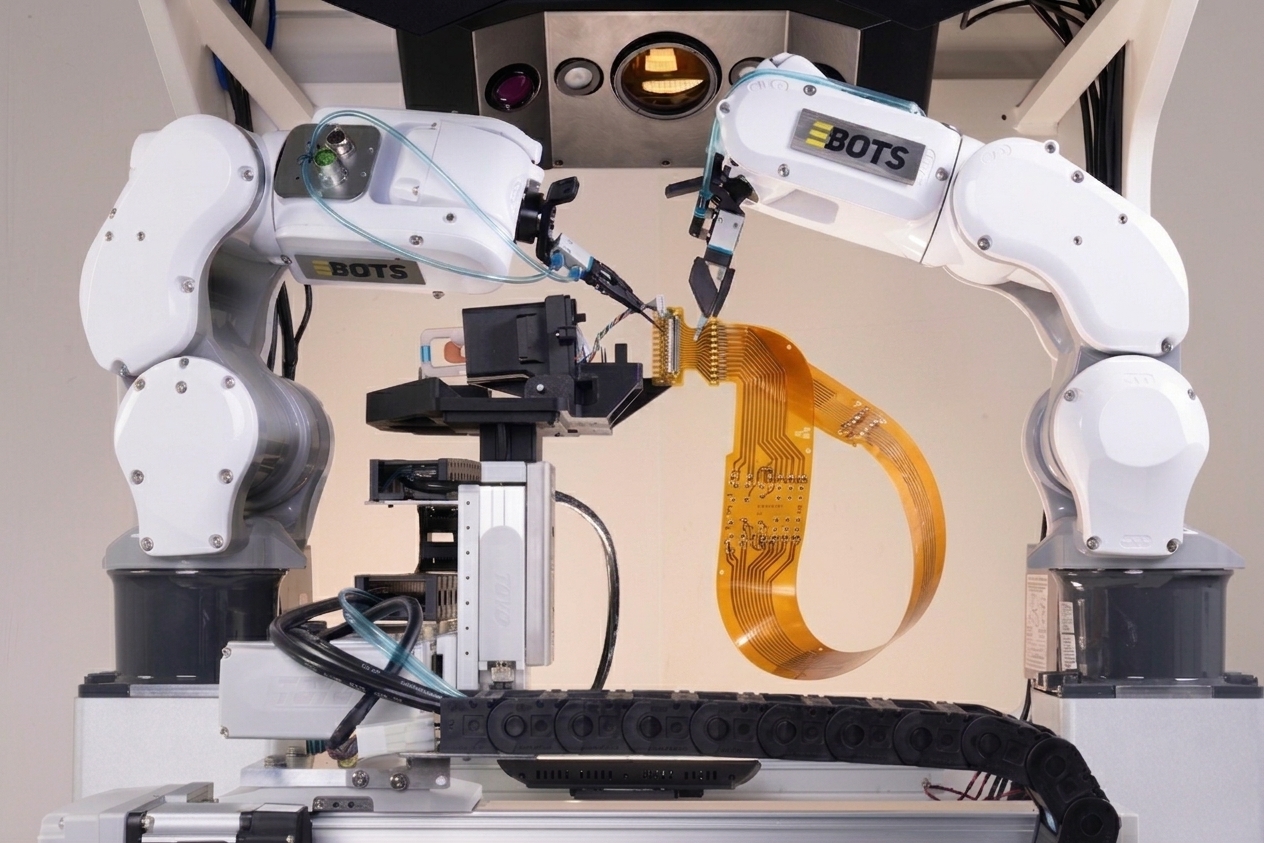
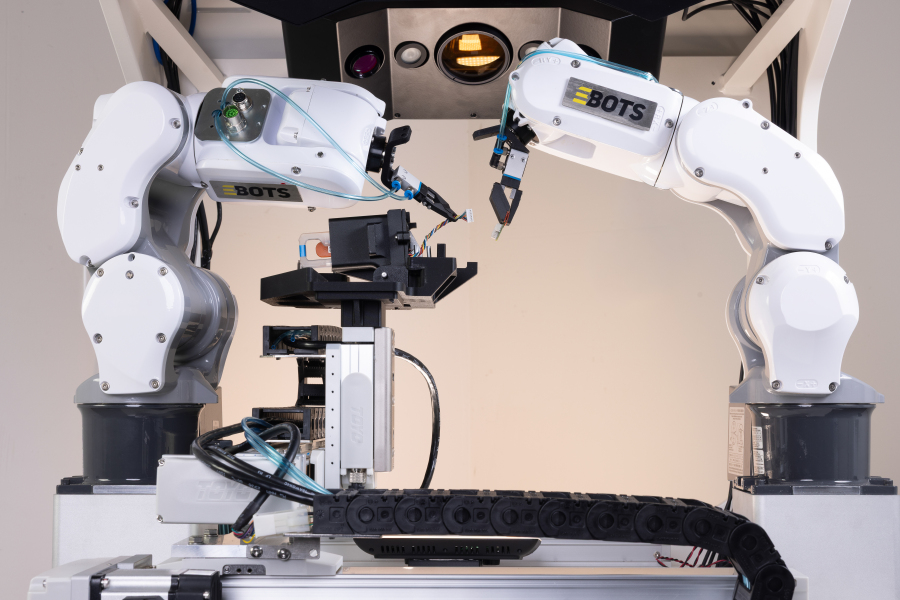
This new generation of intelligent automation is closing the flexibility gap. For example, some advanced dual‑arm robots can learn a new, complex assembly task in about 15 minutes, a process that used to take days. These systems combine cognitive processing with human like dexterity to achieve precision and speed that were previously impossible. They represent the future of manufacturing, where automation is not just powerful, but also agile.
Ready to see how intelligent automation can solve your production challenges? Learn more about the future of manufacturing robots.
The Global Market for Industrial Robots
The industrial robot market is a massive, growing industry. Annual installations regularly exceed 500,000 units, with Asia, particularly China, accounting for around 70% of all new deployments. The automotive industry has long been a major user, but the electronics sector has recently become the largest market, driven by the demand for high precision assembly. This continued growth reflects a global shift toward smarter, more resilient, and more productive manufacturing.
FAQ About Manufacturing Robots
1. What are the main tasks for manufacturing robots?
Manufacturing robots are used for a wide variety of tasks, including welding, painting, assembly, pick and place, packaging, palletizing, machine tending, and inspection.
2. How much do manufacturing robots cost?
The cost varies widely based on size, payload, and application. A small collaborative robot might start around $25,000, while a large, integrated robotic cell for welding could cost hundreds of thousands of dollars. However, the focus should be on the return on investment (ROI), which is often achieved in under two years.
3. Are manufacturing robots safe to work around?
Yes, when installed correctly. Traditional robots operate behind safety fences or light curtains. Newer collaborative robots (cobots) have built-in sensors and force limits that allow them to work safely alongside humans in certain applications, following strict international safety standards like ISO 10218.
4. Will robots take over all manufacturing jobs?
While robots are automating many manual tasks, they are also creating new roles in programming, maintenance, and system oversight. They often take over the most repetitive and dangerous jobs, allowing human workers to move into more skilled and safer positions.
5. How difficult is it to program a manufacturing robot?
It varies. Traditional robots require specialized training. However, a major trend is the development of user friendly interfaces, including graphical programming and lead through teaching, which make it much easier for people without a deep programming background to set up and operate a robot.