Content
Assembly Automation: Guide, Types, ROI and Best Practices
Factories today face a perfect storm of challenges. High labor turnover, sometimes reaching 40% annually, means constantly training new staff. This leads to inconsistent quality, lower yields, and production lines that rarely operate at full capacity. For precision manufacturers, these issues result in wasted materials, missed deadlines, and lost customer confidence. The solution isn’t just about finding more workers—it’s about fundamentally changing the work itself. Assembly automation is the use of machines and control systems to perform assembly tasks with minimal human help, and it’s the key for teams focused on transforming legacy operations.
The shift is already happening on a massive scale. In 2021 alone, a record 517,385 new industrial robots were installed in factories worldwide, bringing the total number of operational robots to an estimated 3.5 million. This guide will walk you through everything you need to know about assembly automation, from the basic components to the advanced AI driving the factories of the future.
The Fundamentals of Assembly Automation
At its core, assembly automation is the use of machines and control systems to perform assembly tasks with minimal human help. This isn’t a new idea. Henry Ford was an early pioneer, using machinery and standardized parts to build the Model T more efficiently. Today, modern assembly automation aims to streamline production, improve quality, and increase output far beyond what manual assembly can achieve.
When applied to a sequential production process, it’s known as assembly line automation. Here, products move through a series of steps, with automated equipment performing specific operations at each stage. The goal is to create a production flow that is faster, more efficient, and incredibly consistent.
The Core Building Blocks of an Automated Line
An automated assembly line is a complex system, but it’s built from a few key types of assembly line component that work together in harmony.
Conveyor System: Think of conveyors as the circulatory system of the factory. These mechanical systems, often belts, rollers, or chains, move parts and products between workstations. A modern conveyor system is more than just a moving belt, it’s often synchronized with the machinery, precisely stopping and starting to position components perfectly for the next operation. In some advanced facilities, Autonomous Mobile Robots (AMRs) are even replacing fixed conveyors to offer greater flexibility.
Workstation Design: A workstation is where the action happens. Proper workstation design is crucial for efficiency and safety. In a manual station, this means applying ergonomic principles and 5S organization to minimize wasted motion and strain for human workers. For an automated station or robot cell, it involves the optimal layout of robots, tools, and fixtures to perform a task and seamlessly hand off the product to the next stage.
Industrial Robot: An industrial robot is a programmable mechanical arm designed for manufacturing tasks. Defined by the ISO as an “automatically controlled, reprogrammable, multipurpose manipulator programmable in three or more axes”, these robots are the workhorses of modern automation. They excel at tasks like welding, painting, and picking and placing parts with superhuman speed and precision.
Control System: The control system is the brain of the operation. It’s a network of devices, most commonly Programmable Logic Controllers (PLCs), that command and coordinate every machine on the line. The control system reads data from sensors and sends signals to motors, robots, and actuators, ensuring every action happens in the correct sequence and at the right time.
Quality Control: In automated assembly, quality control is not an afterthought, it’s built directly into the process. Using sensors and machine vision systems, the line can inspect parts and assemblies in real time. If a defect is found, the system can automatically reject the part or halt production, preventing flawed products from reaching the customer. This continuous monitoring is a key reason automated lines can achieve exceptionally high first pass yields.
What Are the Different Types of Assembly Automation?
Not all automation is created equal. The right automation type for your factory depends on your production volume, product variety, and need for flexibility. There are three main categories.
Fixed Automation
Fixed automation, also called hard automation, is designed to produce a single product in very high volumes. The equipment is highly specialized and performs a fixed sequence of tasks at incredible speed. While the initial investment is high, the cost per unit is extremely low for mass produced items. The downside is its complete lack of flexibility, making it unsuitable for products with frequent design changes.
Programmable Automation
Programmable automation offers a balance between efficiency and flexibility. In these systems, the equipment can be reprogrammed to handle different products or assembly sequences. This makes it ideal for batch production, where a factory might produce a thousand units of one model before switching over to another. Industrial robots are a common component of programmable automation.
Flexible Automation
Flexible automation is the most adaptable type, capable of producing a variety of different products with almost no downtime for changeovers. Enabled by advanced robotics, sophisticated control software, and versatile tooling, these systems can switch from one task to another on the fly. Flexible automation is perfect for environments with a high mix of products, custom orders, or unpredictable demand.
Robotic Automation
Robotic automation specifically refers to the use of industrial robots as the primary means of automation. Because robots are inherently reprogrammable and versatile, this approach often overlaps with programmable and flexible automation. Robotic automation has become a cornerstone of modern manufacturing, used for everything from welding car bodies to assembling delicate electronics, providing a powerful combination of speed, precision, and adaptability.
Advanced Technologies Shaping Modern Manufacturing
The world of assembly automation is evolving rapidly, thanks to a new wave of intelligent technologies that are making factories smarter, faster, and more connected than ever before.
Vision Systems: Giving Machines Eyes
A vision system uses cameras and image processing software to allow automated equipment to “see”. This technology is a game changer for quality control and robotic guidance. Machine vision can inspect parts for tiny defects, verify that components are assembled correctly, and guide a robot’s gripper to pick up parts that aren’t perfectly positioned. The global market for machine vision technology reached nearly 10 billion dollars by 2023, a testament to its critical role in modern production.
Artificial Intelligence and Machine Learning
Artificial Intelligence and Machine Learning are bringing a new level of intelligence to the factory floor. Instead of just following pre written instructions, AI powered systems can analyze data, recognize patterns, and learn from experience to optimize operations. This enables things like predictive maintenance, where an algorithm can predict an equipment failure before it happens, and adaptive control, where a robot can adjust its own motions to handle slight variations in parts. For companies struggling with complex tasks, AI driven systems are now performing precision assembly with reliability that can match or even exceed human workers.
The Internet of Things (IoT)
The Internet of Things, or IoT, connects every sensor, machine, and system in the factory. This network allows for the collection of massive amounts of data in real time. Plant managers can view a live dashboard of the entire production line, identify bottlenecks, and trace the history of every single product that was built. This connectivity is the foundation of the “smart factory” and a key driver of Industry 4.0.
Collaborative Robots (Cobots)
A collaborative robot, or cobot, is designed to work safely alongside human employees without the need for traditional safety caging. Cobots are equipped with sensors that allow them to slow down or stop if they come into contact with a person. This technology blends the strengths of robots (endurance and precision) with the strengths of humans (dexterity and problem solving), enabling automation in tasks that were previously difficult to fully automate.
Augmented Reality (AR)
Augmented Reality enhances a human worker’s view of the real world by overlaying digital information. Using smart glasses or tablets, an assembly worker can see step by step instructions, 3D diagrams, or quality alerts projected directly onto their workpiece. Studies have shown that AR guidance can dramatically speed up training time and reduce assembly errors by nearly 100 percent. A famous Boeing study found that trainees using AR assembled aircraft wiring harnesses 25% faster with almost zero errors.
The Business Case: Why Invest in Assembly Automation?
Implementing assembly automation is a strategic decision that delivers powerful returns across the board. The benefits go far beyond simply replacing manual labor.
Drastic Productivity Improvement: Robots and automated machines can work 24/7 without breaks or fatigue, leading to a massive increase in throughput. This allows factories to meet demand, reduce lead times, and scale production without hiring and training waves of new employees.
Significant Operating Cost Reduction: While there is an upfront investment, automation leads to major operating cost reduction over time. It lowers direct labor expenses, reduces costs associated with employee turnover, and can even decrease energy consumption through optimized processes.
Faster Setups and Changeovers: Modern automation, especially flexible systems, is designed for rapid change. This leads to setup time reduction, allowing manufacturers to switch between different products in minutes instead of hours. A quick tool change capability on a robot means it can adapt to new tasks almost instantly.
Reduced Downtime: Through technologies like predictive maintenance, smart automation systems can anticipate and prevent equipment failures, leading to significant downtime reduction. A line that runs more reliably is a line that is more profitable.
A Safer Work Environment: A key benefit is safety improvement. Automation takes over tasks that are repetitive, strenuous, or hazardous, reducing the risk of workplace injuries. Studies show a direct correlation between increased robot density in a factory and a decrease in work related injuries.
Minimizing Waste: The precision of automated systems leads to remarkable waste reduction. By ensuring every part is assembled correctly within tight tolerances, automation minimizes material scrap and the need for costly rework, boosting first pass yield.
Planning Your Automation Strategy
A successful automation project starts with a solid plan. It involves analyzing your products, processes, and business goals to select and implement the right solution.
How to Select the Right Assembly Automation
Choosing the right technology involves a careful evaluation. Selecting assembly automation requires you to look at your production volume, the complexity of your assembly tasks, and your budget. You must weigh the pros and cons of fixed, programmable, and flexible automation to find the best fit for your specific needs.
Key Planning Considerations
Material and Size Consideration: The physical properties of your parts matter. Are they heavy, fragile, flexible, or tiny? Your material and size consideration will dictate the type of robots, grippers, and feeding systems you need. For example, handling floppy cables or delicate glass requires very different technology than assembling sturdy plastic components.
Part Volume Planning: Your production volume is a primary driver. High volume, stable products often justify dedicated, fixed automation. Lower volumes or a high mix of products point towards more flexible, robotic solutions. Proper part volume planning ensures you don’t overinvest in an underutilized system or underinvest and create a bottleneck.
Part Complexity: How intricate is your assembly? A product with many tiny screws and delicate parts has high part complexity and may require advanced vision systems or highly dexterous robots. Sometimes, it’s best to automate the simpler steps first and leave the most complex tasks for human workers or more advanced systems.
Design Variability: How often does your product design change? High design variability makes fixed automation risky. If you have many product variants or frequent engineering updates, a flexible and easily reprogrammable system is essential to avoid costly retooling.
Scalability Planning for Future Growth: Think about tomorrow. Scalability planning means designing your automation system so it can grow with your business. A modular approach, where you can add more robotic cells or stations as demand increases, provides a future proof path to expansion without requiring a complete system overhaul.
Automating Specific Processes
Welding Automation: In industries like automotive manufacturing, welding automation is standard practice. Robots can lay down consistent, high quality welds at speeds and with a level of precision that is impossible for humans to maintain over a long shift. About 30% of all industrial robots installed globally are used for welding tasks.
Fastening Automation: Similarly, fastening automation (using robots for screwdriving, riveting, or clipping parts together) provides immense benefits. Automated systems can apply the exact amount of torque to every screw, every time, ensuring a secure and reliable assembly while logging the data for quality traceability.
The Financials: Cost and ROI Analysis
Every automation project must be justified financially. A thorough cost and ROI analysis compares the total investment (equipment, integration, training) against the expected savings and benefits (labor reduction, increased throughput, improved quality). Many companies look for a payback period of one to three years, but advanced systems can sometimes deliver a return in a matter of months.
The Implementation Roadmap
Integration Planning: Automation doesn’t exist in a vacuum. Proper integration planning ensures that your new equipment works seamlessly with your existing upstream and downstream processes, from part feeding to final packaging.
System Design and Integration: This is the engineering phase where the detailed layout, programming, and safety systems are developed. Good system design and integration is key to creating a reliable and efficient automated line.
Workforce Training: Your team needs to be prepared. Workforce training is essential for teaching operators, technicians, and engineers how to run, maintain, and troubleshoot the new equipment safely and effectively.
Maintenance and Support: Automated systems require regular upkeep. A plan for maintenance and support, whether using in house staff or a service agreement with your integrator, is critical for long term success and maximizing uptime.
Safety Management: Safety is paramount. Safety management involves risk assessments, designing safety circuits (like light curtains and emergency stops), and ensuring the entire system complies with industry safety standards.
Overcoming Common Automation Hurdles
While the benefits are clear, the path to automation has potential challenges. Being aware of them allows you to plan accordingly.
Addressing the High Initial Cost: There’s no denying the high initial cost of automation. However, when viewed through the lens of ROI, including savings from labor, waste reduction, and increased output, the investment often pays for itself quickly. Financing and leasing options can also make the initial expense more manageable.
Solving Maintenance and Repair Challenges: A maintenance and repair challenge can arise if your team isn’t prepared. Investing in training and having a solid support plan in place is crucial to keeping your equipment running smoothly and minimizing downtime.
Navigating System Integration Challenges: The system integration challenge involves making disparate pieces of equipment from different vendors communicate and work together. Working with an experienced integration partner can help you avoid the pitfalls of a poorly integrated system.
The Importance of Workforce Training: A workforce training challenge occurs when employees are not adequately skilled to operate the new technology. Planning for comprehensive training from the beginning ensures a smooth transition and empowers your team to take ownership of the new systems.
Managing Resistance to Change: Automation can be intimidating for employees who fear their jobs are at risk. Open communication and a clear plan for retraining and redeploying staff are key to managing resistance to change and getting buy in from your entire team.
Design for Automated Assembly (DFAA): Your Blueprint for Success
One of the most powerful strategies for ensuring a successful automation project is to design the product with automation in mind from the very beginning. This discipline is called Design for Automated Assembly, or DFAA.
What is Design for Automated Assembly?
DFAA is a set of principles aimed at making a product as easy and cost effective to assemble as possible, specifically for automated equipment. By simplifying the product and its components, you simplify the automation needed to build it.
Core DFAA Principles
Design Simplification: The most important rule. Design simplification focuses on reducing the total number of parts in an assembly. Fewer parts mean fewer feeders, fewer robotic motions, and a faster, more reliable process.
Correct Orientation Design: Correct orientation design involves adding features that prevent parts from being installed incorrectly. Asymmetrical features ensure a part can only be inserted one way, eliminating a common source of error for automated systems.
Self Locating Feature: A self locating feature, like a chamfer on a hole or a tapered peg, helps guide parts into the correct position during assembly. This makes the process more tolerant of slight misalignments.
Joining Method Selection: The choice of joining method selection is critical. For example, designing parts with a snap fit feature can eliminate the need for screws, adhesives, or other fasteners, which are often more complex and time consuming to handle automatically.
Part Handleability for Gripper: Consider how a robot will pick up each part. Good part handleability for gripper means designing components with flat, stable surfaces that a robotic gripper or vacuum cup can easily grasp.
Top Down Assembly: Whenever possible, design the product for top down assembly. This means all parts are inserted from the same direction (vertically), which simplifies the robotic motions and eliminates the need to flip the assembly over.
Modular Product Design: A modular product design breaks a complex product down into simpler, self contained sub assemblies. These modules can often be built and tested independently on simpler automated cells before being brought together for final assembly.
Poka Yoke (Mistake Proofing): Poka yoke is a Japanese term for mistake proofing. It involves designing features that make it physically impossible to assemble a product incorrectly, a core tenet of DFAA that builds quality into the design itself.
Working with an Expert Partner
Navigating the complexities of automation can be daunting. This is where the engineering consultant role becomes invaluable. An experienced partner can help you analyze your processes, identify the best opportunities for automation, calculate a realistic ROI, and design a system that is perfectly tailored to your needs. They bring a wealth of experience from other projects and can help you avoid common mistakes.
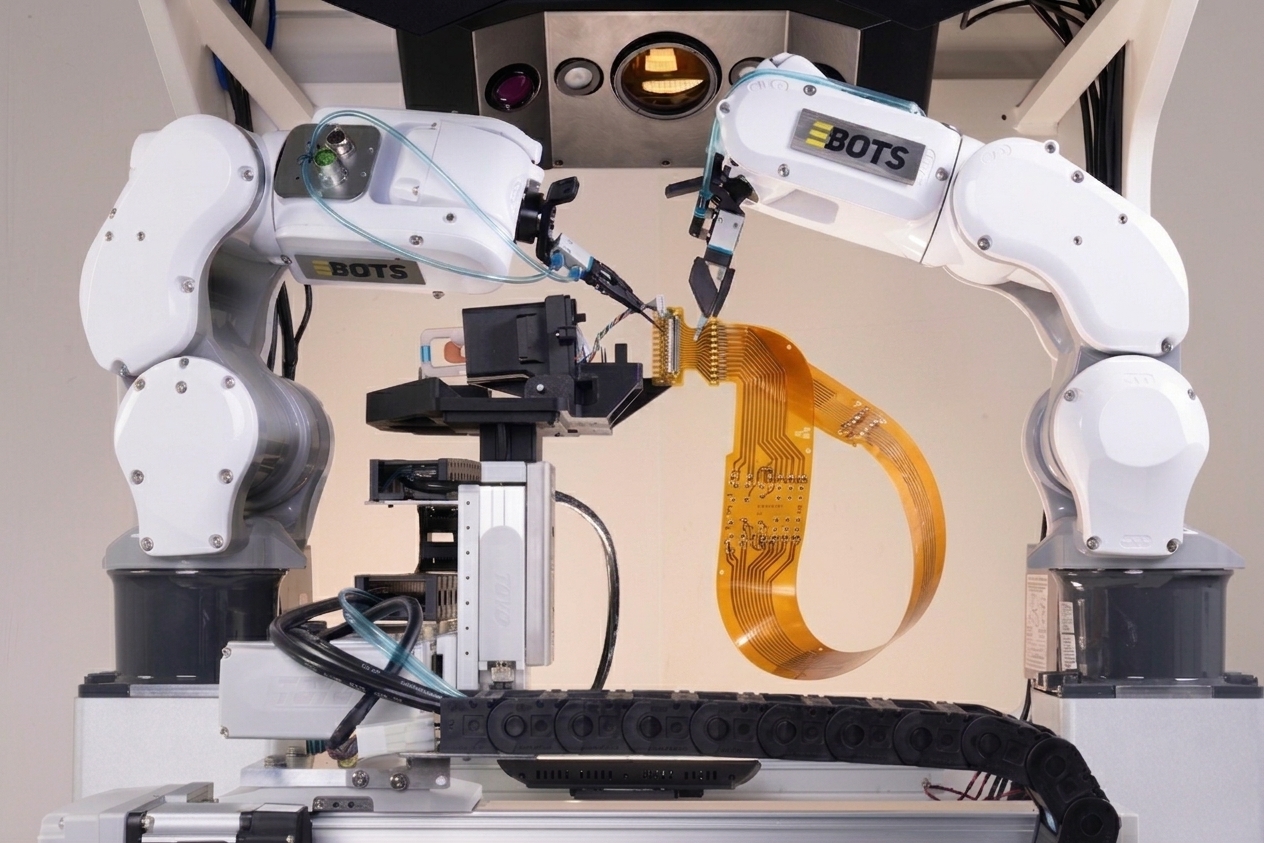
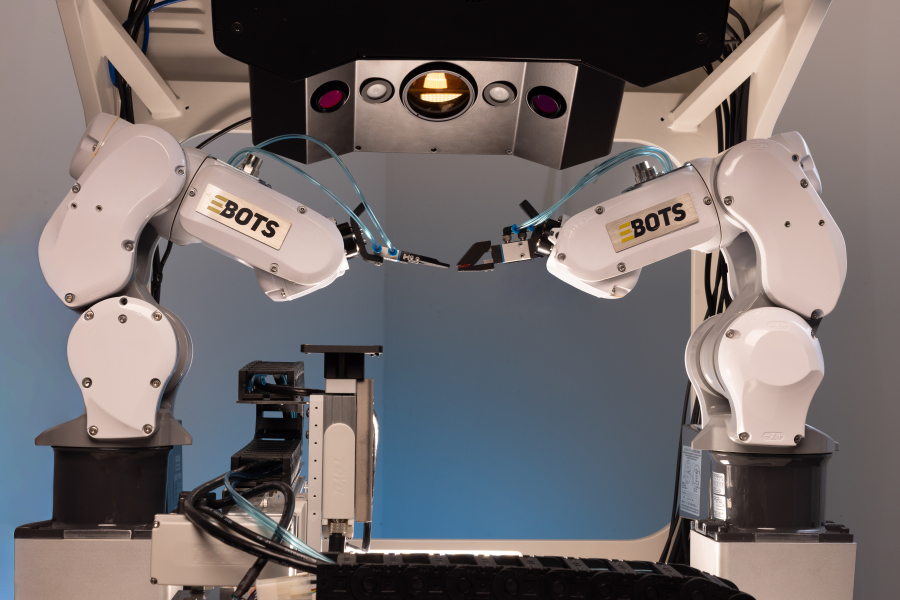
For manufacturers looking to leapfrog legacy systems, partnering with a specialist in advanced robotics can unlock new levels of performance. Explore Ebots’ dual-arm AI robotic cells to see how AI and dual‑arm dexterity can solve complex assembly challenges that were previously thought to be impossible to automate.
The Future of Assembly Automation
The future of assembly automation is intelligent, flexible, and fully connected. We are moving towards “lights out” manufacturing, where factories can run with minimal human supervision, driven by AI that continuously optimizes the production process.
Key trends shaping the assembly automation future include:
Greater Intelligence: AI and machine learning will make assembly lines self optimizing.
Seamless Human Robot Collaboration: Cobots will become even more capable and intuitive, working as true partners to human employees.
Modular and Reconfigurable Production: Factories will be built from flexible, modular cells that can be rearranged on the fly to meet changing demands.
Advanced Dexterity: New dual arm robots, equipped with cognitive vision, are already tackling tasks that require human like dexterity, such as handling flexible cables and assembling intricate components. These systems are proving that even the most complex precision assembly can be automated.
Zero Defect Manufacturing: With 100% in line inspection and AI driven process control, the goal of producing zero defects is becoming a reality.
The incredible pace of innovation means that the capabilities of assembly automation are expanding every day. For businesses ready to embrace this future, the rewards will be unprecedented levels of productivity, quality, and competitiveness.
Frequently Asked Questions about Assembly Automation
1. What is the main benefit of assembly automation?
The primary benefit is a significant increase in productivity and consistency. Automated systems can produce high quality products at a faster rate than manual assembly, while reducing errors and waste.
2. Is assembly automation only for large companies?
No. While large manufacturers were early adopters, the development of more affordable and flexible solutions like collaborative robots has made assembly automation accessible and financially viable for small and medium sized businesses as well.
3. Can automation handle complex or delicate assembly tasks?
Yes. Modern robotic systems, especially those equipped with advanced 3D vision, force feedback, and AI, can perform incredibly complex and delicate tasks. For example, dual arm robots can handle flexible wires and assemble components with micron level precision.
4. How long does it take to see a return on investment (ROI) from automation?
The payback period varies depending on the project, but many companies see a full ROI in one to three years. For some high value applications where automation dramatically increases yield and reduces labor costs, the payback can be less than a year. A detailed ROI analysis is a key part of the planning process.
5. Will automation replace all manufacturing workers?
Automation is transforming manufacturing roles, not eliminating them. It frees human workers from repetitive, strenuous, and dangerous tasks, allowing them to focus on more valuable activities like problem solving, quality assurance, and system maintenance. The factory of the future will be a place where humans and robots collaborate.
6. How do I get started with assembly automation?
A great first step is to conduct a thorough review of your current production processes to identify bottlenecks and areas with high labor costs or quality issues. Partnering with an automation expert can help you assess your needs and develop a clear strategy. To understand what’s possible with the latest technology, schedule a consultation with a specialist in AI‑driven robotics.