Content
Robotic Manufacturing Automation: Benefits, Types & ROI
Robotic manufacturing automation is no longer a futuristic concept, it’s the engine of modern industry. For any manufacturer dealing with high labor turnover, inconsistent quality, and the pressure to scale, automation offers a clear path forward. It transforms legacy production lines, which often rely on manual work, into high‑efficiency operations that deliver consistent quality and faster time to market.
This guide explores the world of robotic manufacturing automation, from its history and the different types of robots available to the benefits, challenges, and advanced technologies shaping the factories of tomorrow.
The Evolution of Manufacturing Robotics
The journey of robotic manufacturing automation began long before the complex machines we see today. While early concepts of automated machines trace back centuries, the first true industrial robot arm, Unimate, was installed at a General Motors factory in 1961. This marked the dawn of a new era.
The growth was explosive. From just 200 robots in use in 1970, the number grew to over 3 million active industrial robots worldwide today. By 2022, the global operational stock of robots hit an incredible 4.28 million units. This rapid adoption, an 85% increase in just five years between 2014 and 2019, was fueled by advancements in computing and the relentless push for greater efficiency.
Initially, robots were brought in to handle the “dull, dirty, and dangerous” jobs, significantly improving workplace safety. Instead of enduring heavy machinery and hazardous fumes, workers could supervise robots from a safe distance. Over time, these machines grew more sophisticated, incorporating machine vision in the 1980s and now leveraging AI and cloud data to create smart, productive, and safe workplaces.
What Are the Types of Industrial Robots?
An industrial robot is an automatically controlled, reprogrammable machine that can move on multiple axes. While there are many variations, they can be grouped into several major categories based on their mechanical structure.
Articulated Robot
When you picture a robot arm, you’re likely thinking of an articulated robot. With a series of rotary joints, these robots mimic the flexibility of a human arm. They typically have six axes of rotation (or degrees of freedom), allowing them to reach around objects and work at complex angles. This makes them perfect for tasks like welding, painting, and machine tending. Their versatility has made them the most widely used type of robot in manufacturing.
SCARA Robot
SCARA stands for Selective Compliance Articulated Robot Arm. These robots are champions of speed and precision in a horizontal plane. With four axes, they are exceptionally rigid vertically but flexible horizontally, making them ideal for rapid pick and place operations and vertical assembly tasks like inserting pins or screws. You’ll often find SCARA robots in the electronics industry, where they perform high speed assembly with incredible cycle times.
Delta Robot
Often called a “spider robot,” the delta robot (a type of parallel robot) is built for lightning‑fast, precise movements of light payloads. It uses three or four lightweight arms connected to a single platform. Because its heavy motors are fixed to the base frame, the moving parts have very little inertia, enabling extremely high speeds. Delta robots dominate high speed pick and place applications in the food, pharmaceutical, and electronics industries.
Cartesian Robot
Also known as a linear or gantry robot, a Cartesian robot operates on three linear axes: X, Y, and Z. This gives it a box shaped work envelope and makes it highly precise and rigid. Often mounted overhead, these robots are excellent for covering large areas while saving floor space. You’ll see them used for large scale pick and place tasks, CNC machining, and even 3D printing.
Collaborative Robot (Cobot)
A collaborative robot, or cobot, is designed to work safely alongside humans without the need for traditional safety cages. Equipped with advanced sensors and force limiting joints, cobots stop or slow down upon contact, preventing injury. This allows for true human robot collaboration, where a person can handle delicate, decision based tasks while the cobot performs repetitive or strenuous motions right next to them.
Autonomous Mobile Robot (AMR)
Unlike stationary robot arms, an Autonomous Mobile Robot (AMR) navigates freely through a facility to transport materials. Using cameras, LiDAR, and intelligent mapping software, AMRs can dynamically plan routes and avoid obstacles. They are a massive leap forward from older Automated Guided Vehicles (AGVs) which followed fixed paths. In 2019 alone, sales of professional service robots, including logistics robots, jumped by 30% as companies embraced this flexible automation.
Specialized Robot
A specialized robot is any robot custom built or configured for a niche application that a general purpose robot can’t handle. This could be a palletizing robot with an arm optimized for lifting boxes, a dual arm robot that mimics two handed human work, or a flexible “snake arm” robot for inspections inside aircraft wings.
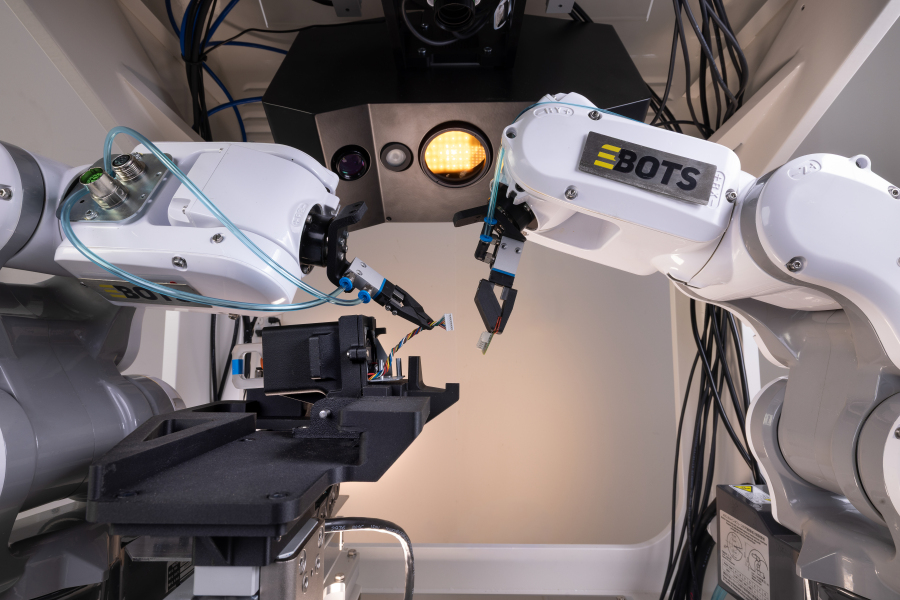
For the most complex challenges, specialized solutions are key. For instance, Ebots has developed a dual arm AI robot designed for intricate precision assembly. It uses advanced 3D vision and synchronized arms to handle deformable parts like wires and cables, a task notoriously difficult for standard robots. This specialized system achieves an incredible 22 μm precision and can perform multi step tasks with over 99.9% accuracy, solving previously unsolvable automation problems.
What are the Benefits of Robotic Automation?
Adopting robotic manufacturing automation delivers powerful advantages in productivity, quality, and cost. Robots can operate 24/7 without breaks, dramatically increasing output. They perform tasks with high precision and repeatability, which reduces errors and boosts product quality. A global survey found that 88% of businesses that adopted robotics saw improved productivity.
Safety Improvements
One of the most significant benefits is improved workplace safety. Robots take over hazardous jobs involving intense heat, toxic fumes, or heavy lifting, protecting human workers from injury. Early robot adoption in the auto industry was driven by a desire to remove people from dangerous press operations. By automating ergonomically challenging tasks, such as lifting heavy parts or performing repetitive motions, companies can drastically reduce musculoskeletal injuries and create a healthier work environment.
Cost Savings and ROI
While robots require an initial investment, they deliver substantial cost savings and a strong return on investment (ROI). They reduce direct labor costs, minimize material waste through higher precision, and increase throughput.
For many automation projects, the payback period is often under two years. For a breakdown of costs, safety, and use cases, see our Industrial Cobots 2025 guide. In some cases, the ROI is even faster. For example, an advanced robotic cell from a provider like Ebots can eliminate the need for an entire manual workstation, saving over $75,000 annually in labor and overhead costs. This allows the investment to pay for itself in a matter of months, not years.
What are the Challenges of Robotics Integration?
Despite the clear benefits, integrating robots is not without its challenges. The upfront cost can be a hurdle, especially for smaller companies. Furthermore, successful deployment requires specialized expertise in engineering, programming, and safety compliance, skills that many manufacturers may not have in house.
Technical Integration and Interoperability
Making a new robot work seamlessly with existing legacy equipment can be complex. Different machines often use different communication protocols, requiring custom software or hardware to bridge the gap. Ensuring a robot, its sensors, and the production line control system can all “talk” to each other is a common technical puzzle that requires careful planning and engineering.
Regulatory and Compliance
Robotic systems must adhere to strict safety standards, such as ISO 10218 and ANSI/RIA R15.06. This involves conducting a thorough risk assessment to identify and mitigate potential hazards. For collaborative robots, additional specifications like ISO/TS 15066 define safe force and pressure limits for human contact. Depending on the industry, such as food or pharmaceuticals, there may be additional regulations regarding hygiene and validation that must be met.
Human Robot Collaboration and Upskilling
Introducing robots into the workforce requires thoughtful change management. Instead of replacing workers, the goal of modern automation is to augment their abilities. Studies have shown that human robot teams can be up to 85% more productive than either working alone. This shift requires upskilling, where employees are trained to operate, program, and maintain the new robotic systems. This transforms manual labor jobs into more technical, higher value roles, empowering the workforce and improving morale. This vision of freeing humans from monotonous tasks to focus on creativity and problem solving is a core principle for innovators like Ebots.
Modern Strategies for Adopting Automation
Navigating the path to automation is more accessible than ever, thanks to new business models and strategic approaches designed to lower barriers for manufacturers of all sizes.
Readiness Assessment and Automation Audit
Before investing, a thorough readiness assessment or automation audit is crucial. This process involves analyzing existing workflows to identify the best opportunities for automation. An audit helps pinpoint tasks that are repetitive, ergonomically challenging, or a source of quality issues. This data driven approach ensures that the investment is targeted where it will deliver the most significant impact and the fastest ROI.
Implementation Strategy: Pilot and Scaling
A common strategy is to start small with a pilot project. By automating a single, well defined task, a company can prove the concept, build internal expertise, and demonstrate a clear ROI. The success of the pilot builds confidence and momentum, providing a solid foundation for scaling the robotic manufacturing automation across other parts of the facility in a phased, manageable way.
Robotics as a Service (RaaS)
Robotics as a Service (RaaS) is a business model that makes automation accessible without a large upfront capital investment. Instead of buying a robot, a company pays a subscription or usage based fee to a provider who owns, manages, and maintains the equipment. This converts a capital expense into a predictable operating expense, lowering the financial barrier to entry and shifting the risk of maintenance and obsolescence to the provider.
Considerations for Small Manufacturers
For small and medium sized manufacturers (SMEs), automation can seem daunting. However, with the right approach, it is highly achievable. User friendly collaborative robots, turnkey solutions from system integrators, and flexible RaaS models are all designed to help smaller operations. By starting with a clear pain point, leveraging external expertise, and focusing on flexible systems that can handle high mix, low volume production, even a small shop can reap the rewards of robotic manufacturing automation.
Advanced Manufacturing Applications for Robotics
In advanced manufacturing, robots are more than just machines performing simple, repetitive tasks. They are integral components of a connected, intelligent production ecosystem.
Machine Vision in Quality Inspection
Integrated with machine vision, robots can perform 100% quality inspection at production speed. High resolution cameras and AI powered software allow robots to detect tiny defects, verify dimensions, and ensure correct assembly with superhuman consistency. This real time feedback loop helps catch errors the moment they occur, dramatically reducing scrap and ensuring only perfect products reach the customer.
Material Handling and Logistics Automation
From the warehouse to the assembly line, robots are automating the flow of materials. AMRs transport parts just in time, while robotic arms palletize finished goods. Amazon famously uses hundreds of thousands of mobile robots in its fulfillment centers to bring shelves to workers, tripling picking efficiency. This level of logistics automation creates a lean, efficient, and continuous flow of production.
Kitting and Sequencing Automation
Kitting and sequencing are critical logistics tasks where robots excel. A robot can be programmed to pick a precise set of components to create a “kit” for a specific assembly step. In more complex operations, robots can sequence these kits or individual parts to match the production schedule of a mixed model assembly line perfectly, ensuring each station gets exactly what it needs for the specific product variant being built.
ERP Integration with Robotics and AI
True smart factories integrate robotic operations with high level business systems like Enterprise Resource Planning (ERP). When an order is entered into the ERP, it can automatically trigger robots on the floor to begin production. The robots, in turn, feed real time data on progress, material consumption, and quality back into the ERP. This creates a seamless digital thread from the top floor to the shop floor, enabling agile, data driven manufacturing.
Real Time Operational Visibility
Connected robotic systems provide real time operational visibility. Managers and engineers can monitor production status, machine health, and quality metrics from anywhere via live dashboards. This allows for proactive decision making, enabling teams to address bottlenecks or quality deviations instantly instead of waiting for end of shift reports.
Predictive Maintenance for Robots
By analyzing data from sensors on a robot’s motors and joints, AI algorithms can predict when a component is likely to fail. This practice, known as predictive maintenance, allows teams to schedule repairs just in time, before a breakdown occurs. This proactive approach minimizes unplanned downtime and maximizes the operational life of the equipment.
The Future is Intelligent: AI and Next Gen Robotics
The next wave of robotic manufacturing automation is being driven by artificial intelligence and other emerging technologies that make robots smarter, more adaptable, and easier to use.
Physical AI for Robotics
Physical AI is the combination of advanced AI software with a robot’s physical body, allowing it to perceive, reason, and interact with the physical world in a more intelligent and human like way. This enables robots to handle variability and perform complex tasks that were previously impossible to automate, such as assembling delicate or non rigid parts.
Closed Loop AI Control
With closed loop AI control, robots can learn and adapt on the fly. A robot equipped with sensors can monitor its own performance and make real time corrections. For instance, if a force sensor detects that a part isn’t fitting correctly, the robot can adjust its path or pressure autonomously, ensuring a successful outcome. This self correcting capability is essential for achieving ultra high yields in precision tasks.
The Role of Edge Computing
Processing the massive amount of data from high resolution cameras and sensors in real time requires immense computational power. Edge computing places this processing power directly on or near the robot, rather than sending data to a distant cloud server. This minimizes latency, allowing for the instantaneous decisions needed for high‑speed, AI‑driven applications, such as the 409 fps processing used in Ebots’ advanced systems.
No Code Robot Training
Historically, programming a robot required specialized coding skills. The future is “no code” training, where operators can teach a robot new tasks through simple, intuitive interfaces or by physically guiding the robot’s arm through the desired motions. This drastically reduces setup times and empowers non experts to reconfigure robots quickly. For instance, some advanced systems can be reconfigured for a new task in as little as 15 minutes, offering unprecedented agility.
Frequently Asked Questions
1. What is robotic manufacturing automation?
Robotic manufacturing automation is the use of industrial robots to perform tasks in a manufacturing process. This can range from simple, repetitive actions like picking and placing parts to complex, multi step assembly operations that require advanced intelligence and dexterity. The goal is to improve productivity, quality, safety, and cost efficiency.
2. How much does an industrial robot cost?
The cost varies widely depending on the type, size, and capabilities of the robot. A small collaborative robot might start in the tens of thousands of dollars, while a large, heavy payload robot or a highly specialized system can cost hundreds of thousands. However, it’s important to consider the total cost of integration and the long term ROI, which is often very compelling.
3. Can small businesses benefit from robotic automation?
Absolutely. With the advent of affordable collaborative robots, user friendly programming interfaces, and flexible models like Robotics as a Service (RaaS), automation is more accessible than ever for small and medium sized businesses. Automating even a single bottleneck task can deliver significant improvements in output and quality.
4. Will robots replace human workers?
The modern view of automation is that robots augment human capabilities, not replace them. Robots are best suited for repetitive, physically demanding, or dangerous tasks, which frees human workers to focus on higher value roles that require creativity, critical thinking, and complex problem solving. This often leads to upskilling the workforce and creating more engaging, technical jobs.
5. What is the difference between an AGV and an AMR?
An Automated Guided Vehicle (AGV) follows fixed, predefined paths, such as magnetic tape on the floor or wires. An Autonomous Mobile Robot (AMR) uses sensors and onboard intelligence to navigate dynamically, meaning it can create its own maps and intelligently maneuver around obstacles, making it far more flexible.
6. How do I know if my facility is ready for automation?
A readiness assessment can help. This involves identifying processes that are repetitive, cause quality problems, or are ergonomically challenging for workers. If you are struggling with labor shortages, high turnover, or inconsistent output, you are likely a strong candidate for robotic manufacturing automation. Consulting with an automation expert can provide a clear roadmap.
7. What is the ROI on robotic automation?
The return on investment (ROI) for robotics can be very rapid. By reducing labor costs, increasing throughput, and minimizing scrap, many projects see a payback period of 1 to 2 years. For highly efficient, specialized systems addressing major pain points, the ROI can be achieved in a matter of months.
8. What is a “turnkey” robotic solution?
A turnkey solution is a complete, ready to use robotic system provided by a system integrator or a company like Ebots. The provider handles everything from the initial design and robot selection to programming, installation, and safety integration. This is an ideal approach for companies that lack in house robotics expertise.